A Media-Ecology Reading
Kimberly Akimbo
Skaters on a thin, mediated layer of ice
The musical Kimberly Akimbo asks to be enjoyed, and it is: a howlingly funny heartbreaker that won five Tony Awards, including Best Musical. But it is also, almost secretly, a show about media—about writing and erasing, recording and broadcasting, and the difference between a world you build together and a world handed to you finished. This is one way to watch it: through the lens of media ecology, the discipline that treats our communication technologies not as tools we pick up but as environments we live inside.
What follows is the original slide talk, opened up. Each panel keeps a slide from the deck and adds an annotation you can read on its own. You do not need the theory in advance—the field guide below defines every term the annotations lean on, and each term is a link back here. Adapted and expanded from a talk for the Media Ecology Association, 2024.
A Field Guide
Seven terms the annotations lean on.
Media ecology
The study of communication media as environments. Following Marshall McLuhan and Neil Postman, it asks how a technology's form—not just its content—reshapes what we perceive, feel, and value.
The medium is the message
McLuhan's slogan: a medium's deepest effects come from the form itself, the new pace, scale, and pattern it imposes, largely regardless of the “content” it carries.
Hot & cool media
McLuhan's pairing. “Hot” media are high-definition and ask little of us; “cool” media are low-definition and pull us in to complete them. A film is hot; a game you must imagine is cool.
The disappearance of childhood
Postman's thesis: print created childhood by locking adult secrets behind the skill of reading; electronic media unlock them, dissolving the wall between child and adult. Kim's body performs that collapse.
Primary & secondary orality
Walter Ong's distinction. Primary orality belongs to cultures with no writing, where knowledge is spoken, performed, communal. Secondary orality is the new, electronically amplified orality (radio, TV, broadcast) that still rests on top of literacy.
Parataxis & hypotaxis
Parataxis strings clauses side by side (“and…and…”), the additive rhythm of oral culture. Hypotaxis subordinates and nests them, the analytic architecture of writing. A tabletop campaign is paratactic; a fixed script is hypotactic.
Simulation & the hyperreal
Jean Baudrillard's terms for signs and copies that have floated free of any original. When a simulation precesses, it comes to us ahead of and instead of the real thing. The hyperreal feels more real than the real; Disneyland is his favorite example—and, not by accident, Kim's last stop.
The Pitch
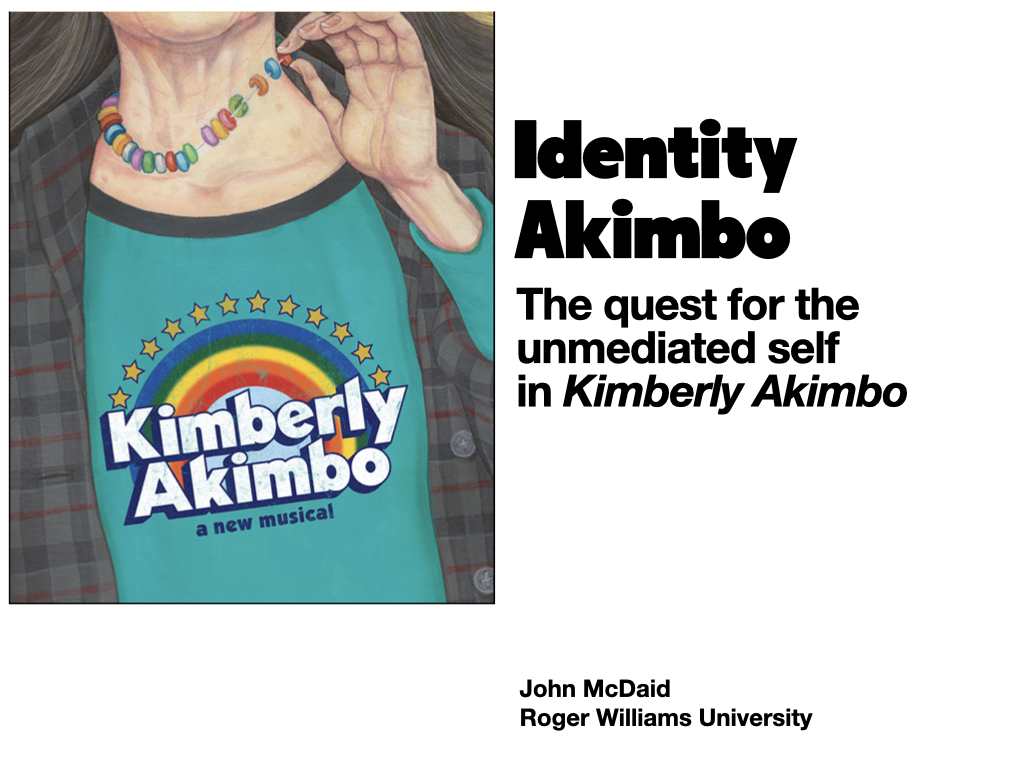
Kimberly Akimbo has book and lyrics by the Pulitzer-winning playwright David Lindsay-Abaire and music by Jeanine Tesori, adapting Lindsay-Abaire's own 2000 play (world premiere at South Coast Repertory in 2001; New York, at Manhattan Theatre Club, in 2003). The musical opened Off-Broadway at the Atlantic Theater Company in 2021, transferred to Broadway in 2022, and closed in April 2024 after 612 performances. Its national tour finished crossing the country in May, 2026.
The story: Kimberly Levaco is turning sixteen with a progeria-like disease that ages her at four-to-five times the normal rate, so she has the body of a woman in her seventies and a life expectancy of about sixteen years. Around her: a first love, a family coming apart, and a felony scheme. That premise is the hook. The claim of this reading is that the show's real subject, underneath the plot, is mediation—which makes media ecology a helpful way to explore it.
A Seventy-Year-Old Teenager
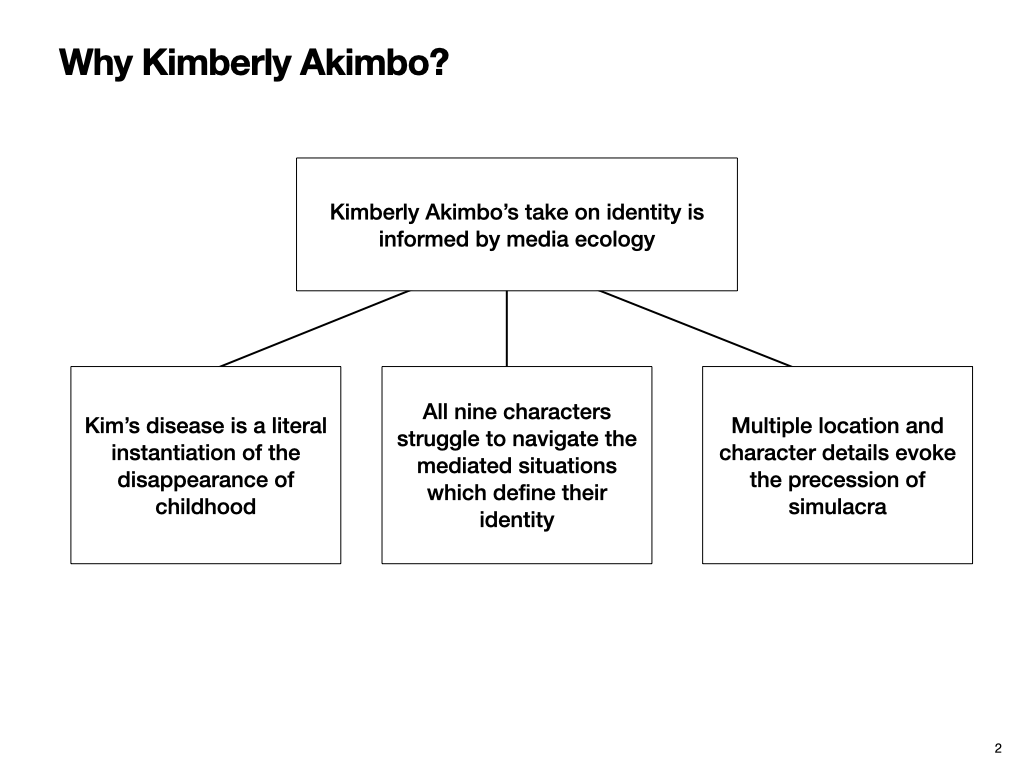
The central conceit—a sixteen-year-old who reads as seventy—literalizes Neil Postman's disappearance of childhood. Postman argued that print invented childhood by putting adult knowledge behind a wall of literacy, and that electronic media tore the wall down, leaving us with children who know everything and adults who know nothing more. Kim's body simply performs the argument: the protected interval between child and adult has collapsed into a single frame.
And it is not only Kim. The show's governing metaphors are all acts of inscription, erasure, and reassembly. Kim is being erased by her own genetic code. Her aunt Debra runs a check-washing scheme—literally dissolving one identity off a document to write in another. Seth, an anagram enthusiast, rearranges “Kimberly Levaco” into cleverly akimbo, naming her out-of-true self. Even the setting is a Baudrillardian sequence of simulations: we begin in an artificial ice rink and end, by way of a safari park, Colonial Williamsburg, and Graceland, at Disney World.
Start From Scratch
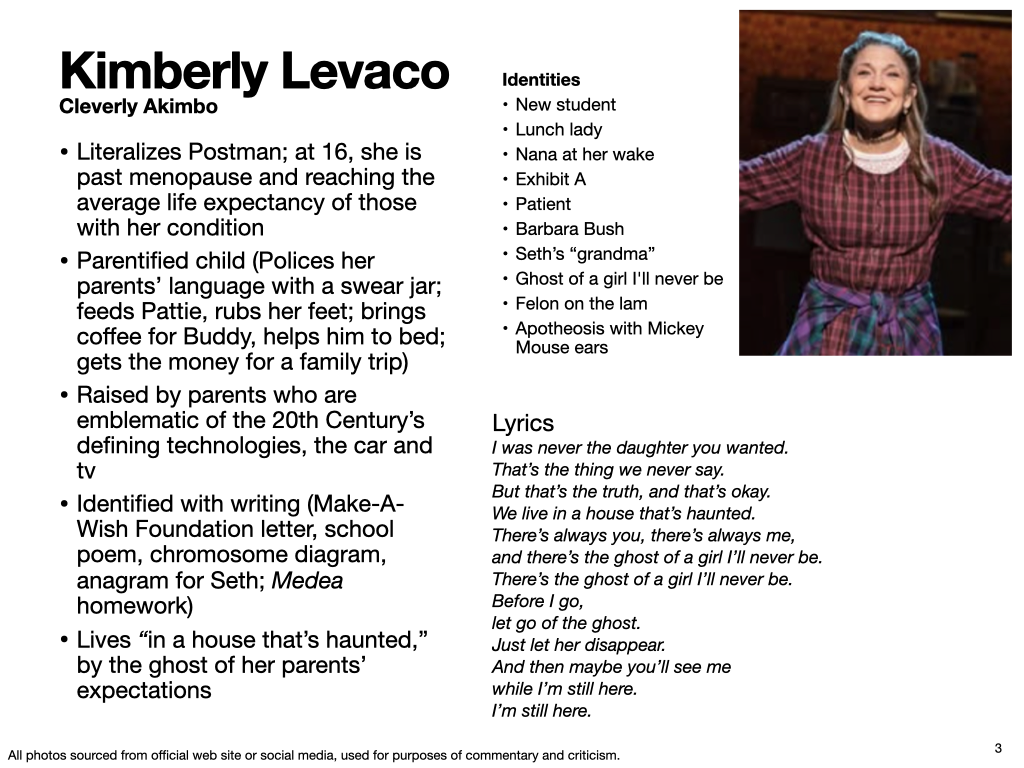
Kim enters as the new girl who gets to “start from scratch.” Something bad happened back in Lodi, something involving Debra, but her parents decide she is better off not knowing—one more adult secret held just out of reach, in a show about the vanishing of exactly those secrets.
Her decisive turn is a refusal of mediated wish-fulfillment. When the Make-a-Wish Foundation offers to build her a treehouse, she declines the gift and chooses instead to go and see the world for herself. Read ecologically, Kim stands in for all of us: skaters on a digital planet, nursing what Lewis Mumford would have called a paleotechnic hangover—still running on the coal-smoke habits of an earlier machine age—and trying to climb out of the hole those habits dug.
Before the Curtain: A Sky Made of Wires
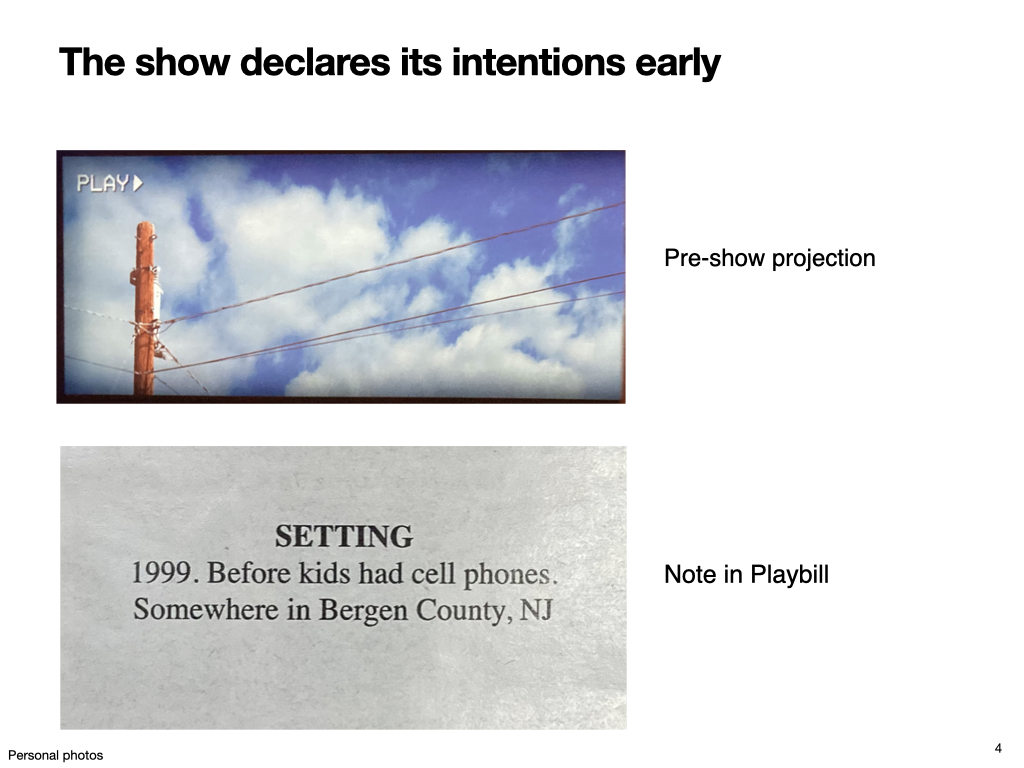
Before a word is spoken, we see a video projection: a New Jersey sky, crossed with utility wires, with clouds moving through it. Couple that with the Playbill's pointed note that the show is set in the years before cell phones, and the creative team has told you how to read everything that follows.
This is McLuhan's the medium is the message staged as a curtain: the first thing we register is not content but an apparatus—a screen, a projection, a landscape already strung with the wires of an older communications grid. In the touring production, where the orchestra is in the pit rather than risers upstage, behind the set is a physical utility pole and wires that looms over the action for the entire show. We are being reminded, wordlessly, that what we are watching is a story about mediated realities.
The World of the Show
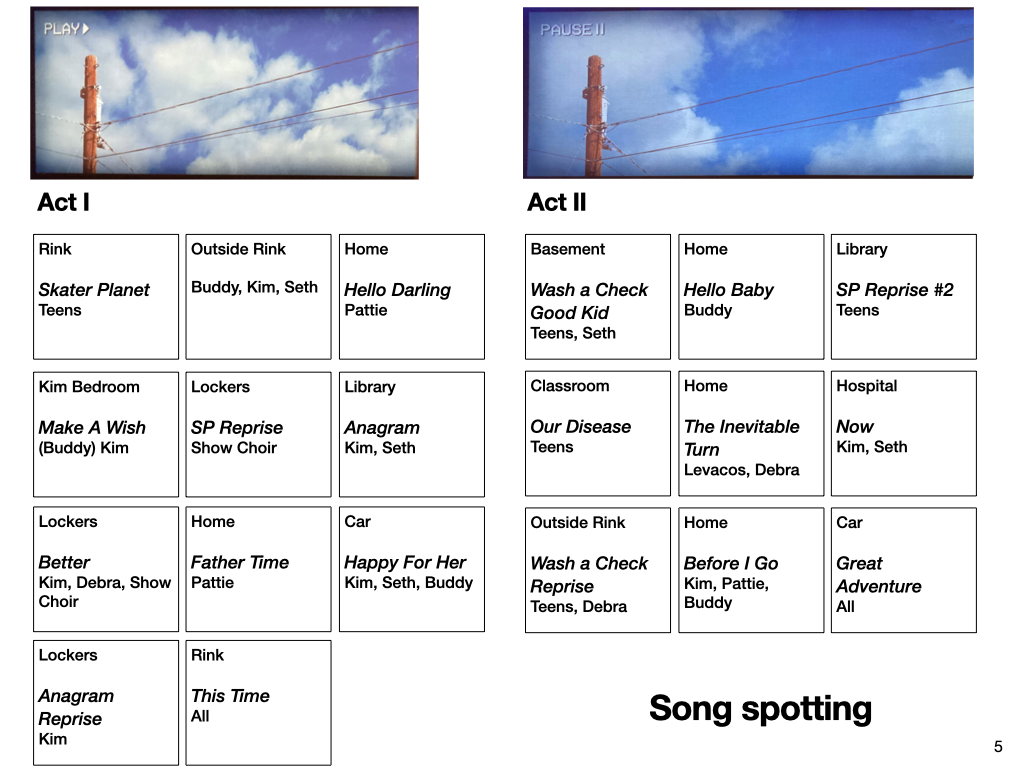
The town has no name. Six teenagers navigate not-fitting-in: Kim; Seth, a geeky wordsmith and tuba player who sees her clearly; and a Show Choir who form a romantic quadrilateral—Martin, Aaron, Teresa, and Delia—meeting at the rink, playing UNO in the library, rehearsing a Motown routine. Buddy drinks; Pattie is pregnant, hypochondriac, and hiding a secret; aunt Debra arrives with a check-washing scam and pulls the kids in. Act II runs from the scheme through a family dinner that detonates the Levacos' secret, to Kim's collapse and, finally, a road trip toward the horizon.
Two details to file away now, because they carry the argument. First, the town's namelessness is an erasure: in the original play the town is Bogota, New Jersey, and a faint stencil of that name survives on a prop later on. Second, the kids play UNO—where the play had them playing Dungeons & Dragons. Hold that substitution; we will return to it, because it is the whole thesis in miniature.
Cadmus's Candy Necklace
The first image is Kim alone in the dark, deliberately biting a bead off a candy necklace. A media ecologist can hardly help hearing an echo of Cadmus's teeth—the myth in which sown dragon's teeth spring up as armed men, long read as a fable of the phonetic alphabet, those small, identical, repeatable units from which whole worlds are assembled. The candy beads are letters; they are also the base pairs of her akimbo DNA. Both codes, alphabetic and genetic, are discrete, recombinable, and, in her case, misspelled.
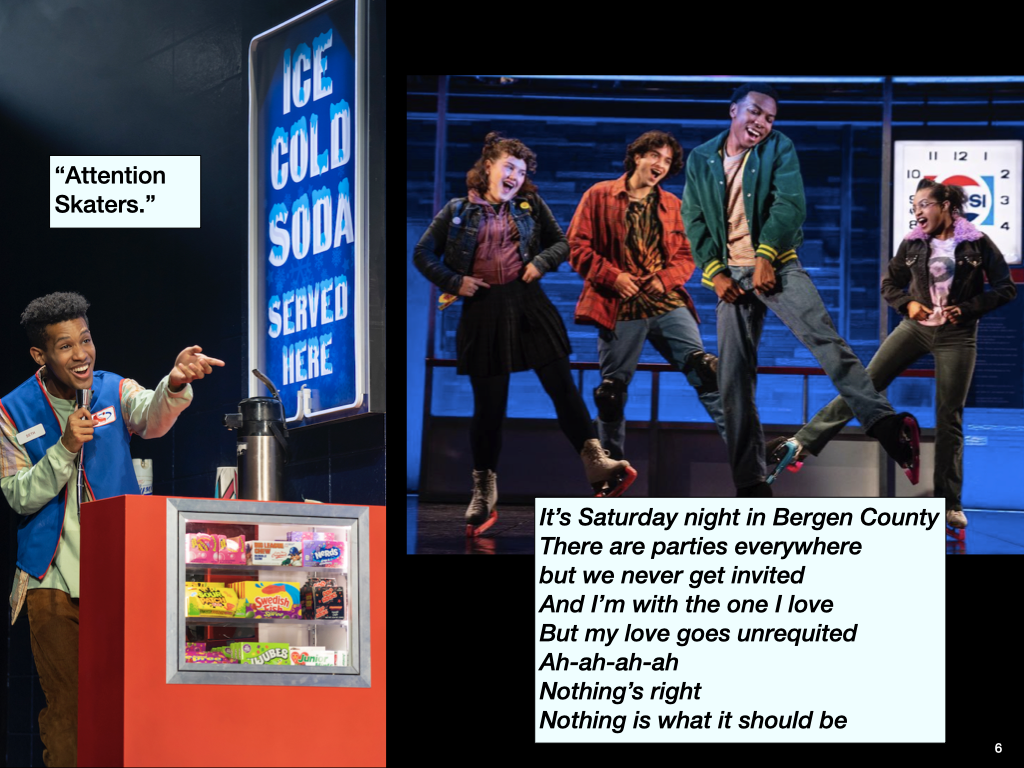
Then the lights rise on an ice rink and the Show Choir sings “Skater Planet.” Why skating? Because it is friction reduced almost to zero—a controlled, contained environment where you can be poised and graceful in a way school never allows, and try on a self you cannot wear outside. The rink is the show's first simulation, a cool and frictionless surface over a colder reality.
Waiting on the Ice
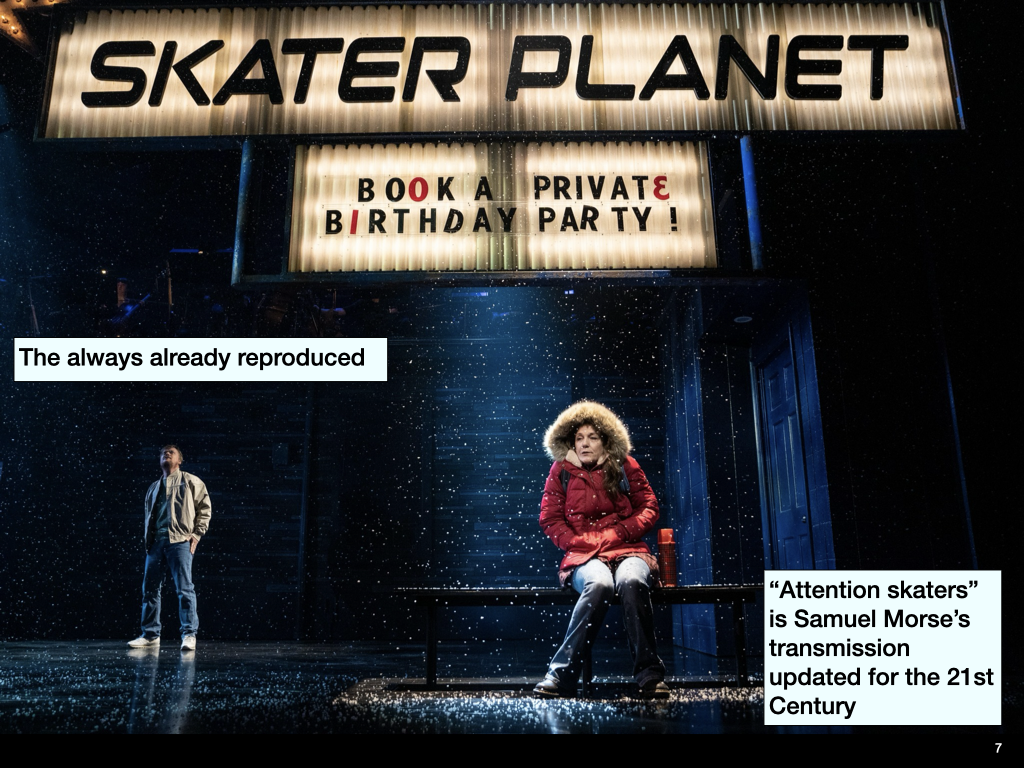
Next we find Kim as a literal outsider, waiting in the cold for her forgetful, inebriated father and the car. The weather does the work of the pathetic fallacy, deepening her isolation. Buddy has won a Game Boy in a bar bet; Kim expertly blows into the cartridge to make it work—a small, exact period gesture, the analog ritual of a pre-network childhood. Seth doubles back for his tuba and offers to let them warm up inside: his “save the cat” moment, the beat that makes us root for him.
“Skater Planet” is the thesis in a hook. The show will move from rink to safari park to Disney World, and the song has already told us what that progression means: we are all skaters on a thin, mediated layer of ice over reality, melting under the blades of our own words. (Keep an ear on the phrase “book a party”; it is foreshadowing.)
Even the Ding-Dongs Are Fake
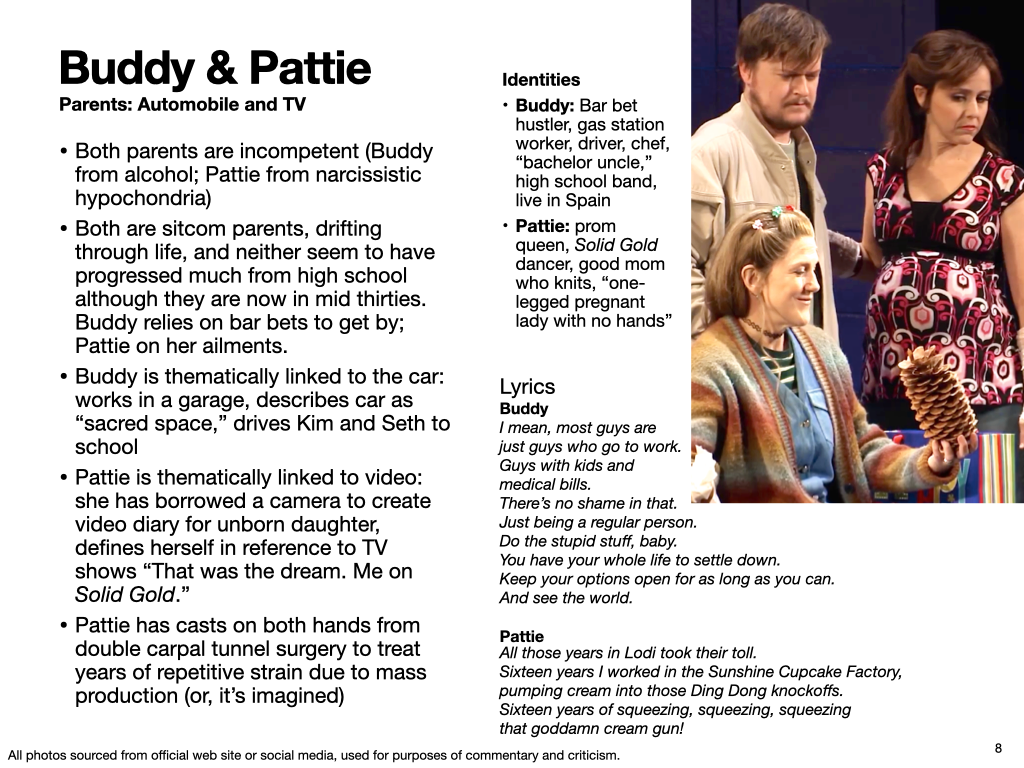
Home is a quiet disaster. Both parents work hard to present as good parents and fail in real time. Pattie gets “Father Time,” a number that is at once a wish to rewind Kim back to babyhood and a hope pinned on the unborn Carmelita (one anagram of whose name, fittingly, is All Envy America). Buddy gets the comic patter song “Happy for Her,” ruminating from the driver's seat about what Seth might want from his daughter—the very thing he once wanted, and got, from Pattie in high school.
The house runs on brand-name simulations of nourishment. In this New Jersey, even the Ding-Dongs are fake: the off-brand snack cake stands in for a whole economy of copies without originals, comfort food that only resembles comfort. Baudrillard would recognize the pantry.
The Parentified Child
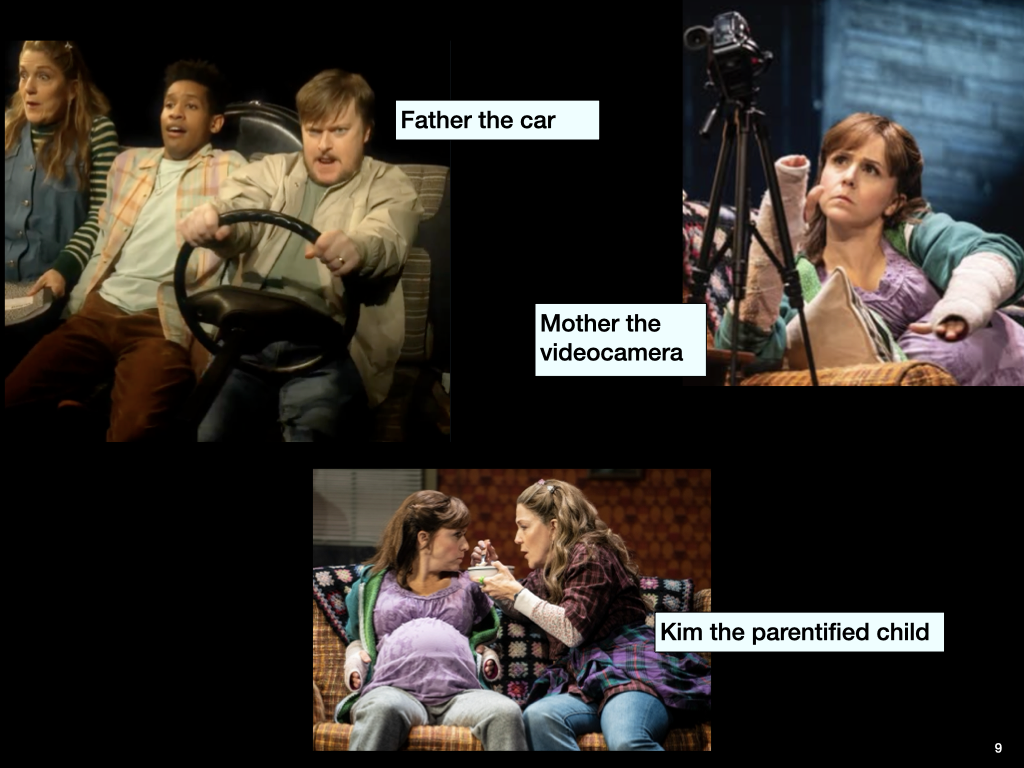
Kim is one of the children of the postindustrial age whose parents cannot meet the moment. Her father can drive but has to be helped to bed; her mother, hands bandaged from double carpal-tunnel surgery, has to be fed like an infant. The roles have inverted—this is the clinical figure of the parentified child, the kid who parents the parents—and it is Postman's collapsed boundary again, this time as family logistics.
The scene is thick with recording devices. Pattie sings “Hello, Darling” into a borrowed camcorder, taping a message for her unborn daughter. As Tesori has noted, in the 1990s self-recording was still a deliberate, unusual act rather than the ambient archiving we do now; the show keeps handing that camcorder around like a talking stick. Kim answers with her own “I want” number, “Make a Wish,” a letter to the Foundation that runs through the whole range of her imagined desires before landing, heartbreakingly, on the wish for an ordinary family dinner.
Anagram: The Turn of a Letter
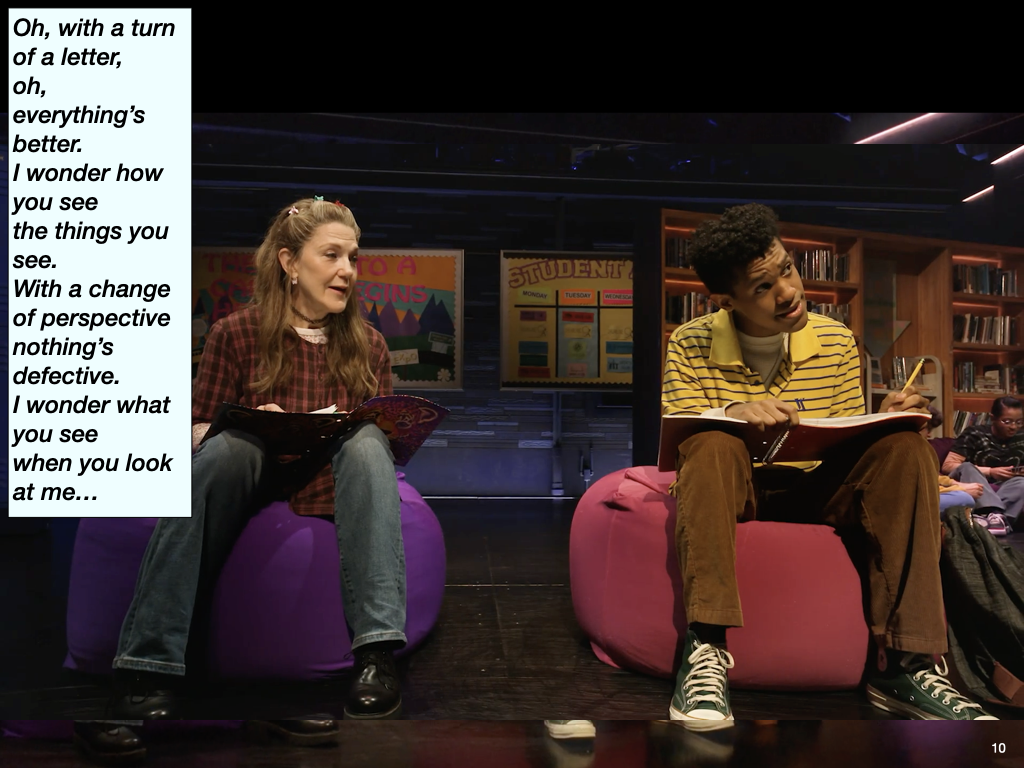
In the library, Kim and Seth plan a biology presentation on disease and choose hers. Seth offers to make an anagram of her name, and the song “Anagram” turns the exercise into a small manifesto: with the turn of a letter, everything can be made better. This is the recombinatory power of writing set to music—the alphabetic promise that a fixed reality can be re-spelled into a different one.
There is a lovely production fact buried here. The rapid-fire, jazz-poet verbal exploration that solves the anagram is a simulation of Lindsay-Abaire: Tesori had him perform an anagram live, taped it, and built the song around the tape. "Even the shouting," as Tesori told Playbill. Every performance therefore contains a hyperreal recreation of the author writing—in a song about inscription.
Seth, or the Cool of Literacy
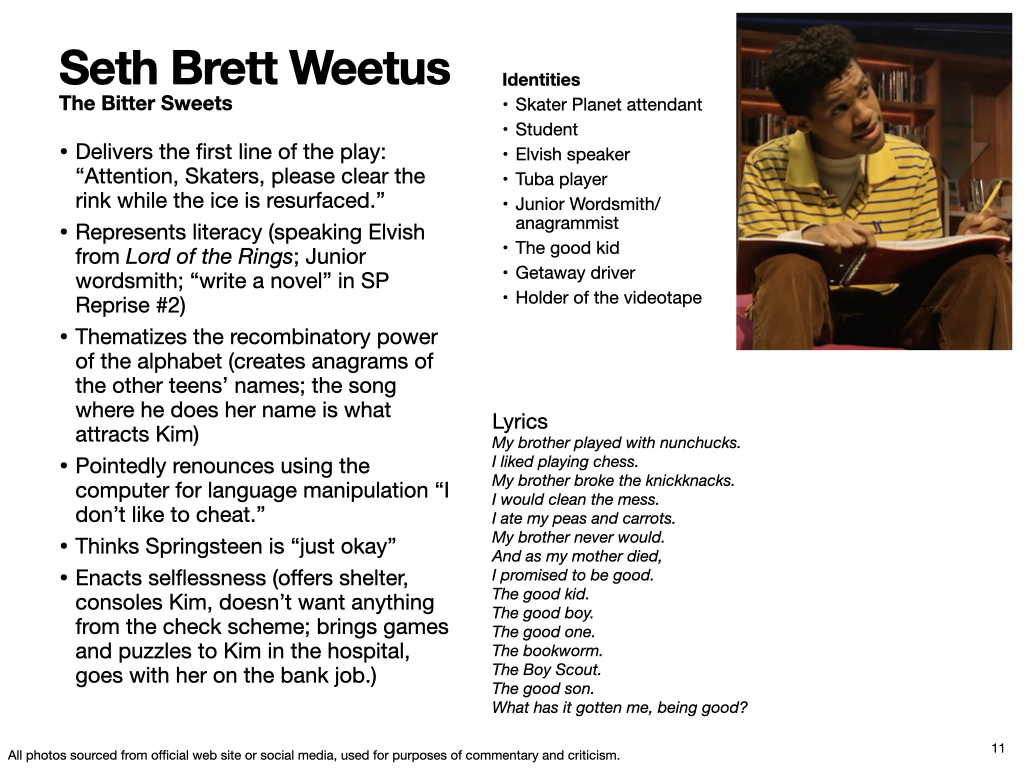
Seth is identified with writing. He is the anagrammatist, the puzzle-solver, the boy who reorganizes the world on paper, and he carries the temperament that Ong and McLuhan attribute to literacy: analytic, distancing, cool. Writing lets you hold experience at arm's length and take it apart; Seth's whole way of loving Kim is to spell her differently, to find the order hidden in her disorder.
This is worth dwelling on, because Seth is where the adaptation performs its cleanest media-ecological maneuver. In the original play the boy is not Seth the anagrammatist at all. He is Jeff—a Dungeon Master. That change, from a figure of oral, improvised storytelling to a figure of literate, written recombination, is not a detail. It is the argument. The next panel is its spotlight.
A Barbarian in the Library
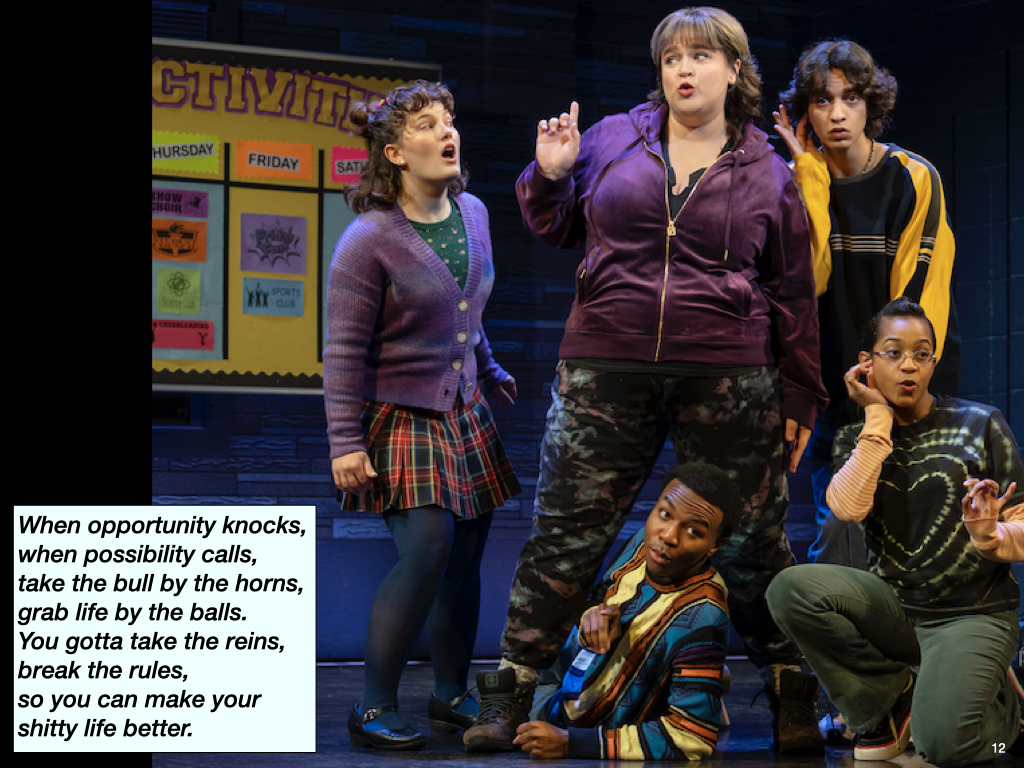
Debra crashes in right after “Anagram”—a barbarian in the library—and offers a rival route to the same word, better, in a big, belting Broadway number. If Seth's “better” is achieved by rearranging letters, Debra's is achieved by rearranging people: forging identities, working an angle, moving money. Two technologies of transformation, the pen and the con, meet over the same card table.
Identity as a Tactic
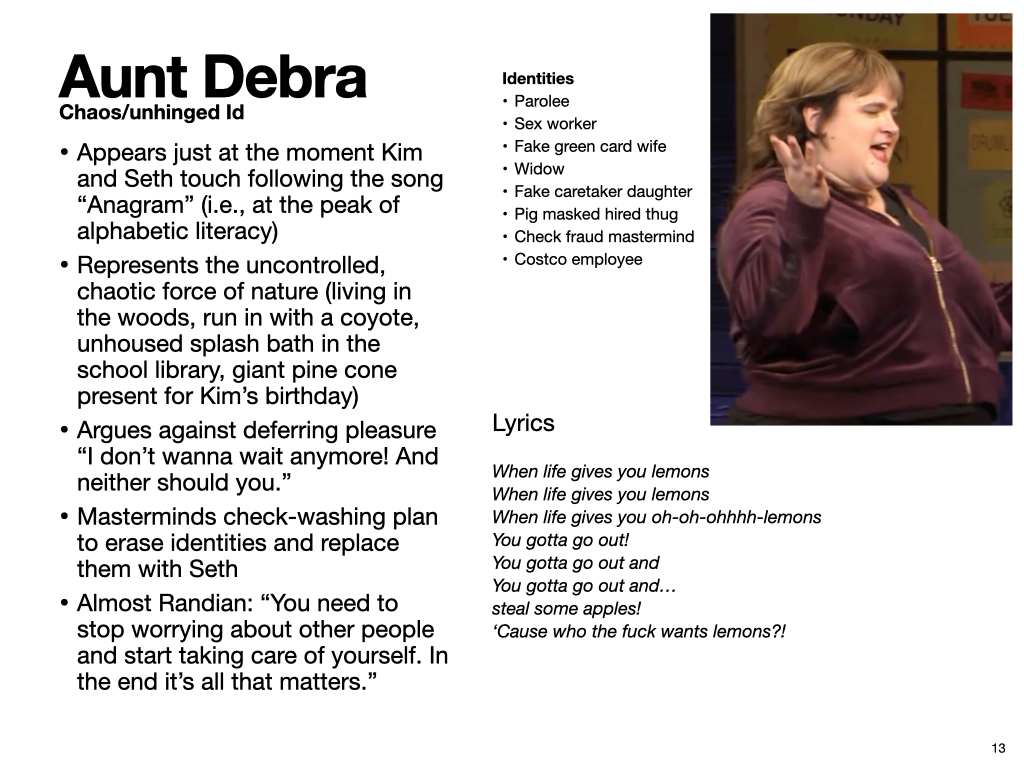
In “Better,” Debra lays out a life lived as tactical impersonation—playing the grieving widow, the devoted daughter, whatever a mark needs to see—in order to get paid. Her famous corrective to the old proverb sets the tone: when life gives you lemons, don't make lemonade; go steal some apples, because who wants lemons? Identity, for Debra, is not something you have but something you deploy: a fund of Baudrillardian personae, copies with no original, cashed as needed. She is the show's theorist of simulation, and its most alive character.
The Last Diegetic Photograph
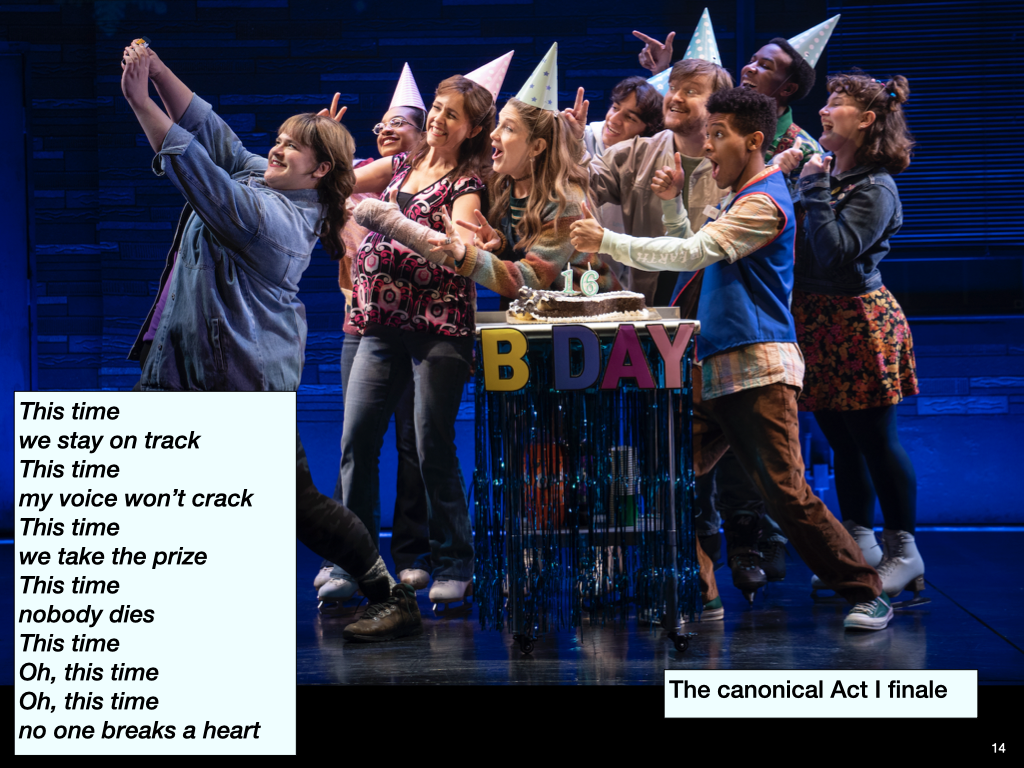
Act I ends with a big production number, "This Time." Everyone is briefly aligned: the parents promising to be better, Kim agreeing to join the check-washing scheme, the Show Choir signing on for costume money and a shot at the state competition. It is the only moment the entire cast is on stage together within the story, and it is marked by an old disposable party camera—a pre-selfie selfie, nostalgic even in 1999, a way of recording a togetherness the family cannot otherwise sustain.
Notice, too, the show's recurring motif of the broken heart made literal: a heart attack in Lodi, Kim's cardiac crisis to come in Act II, Pattie's collapse in a Panera. The organ that stands for feeling keeps failing as a physical machine—emotion rendered, repeatedly, as hardware.
Futures She Will Never See
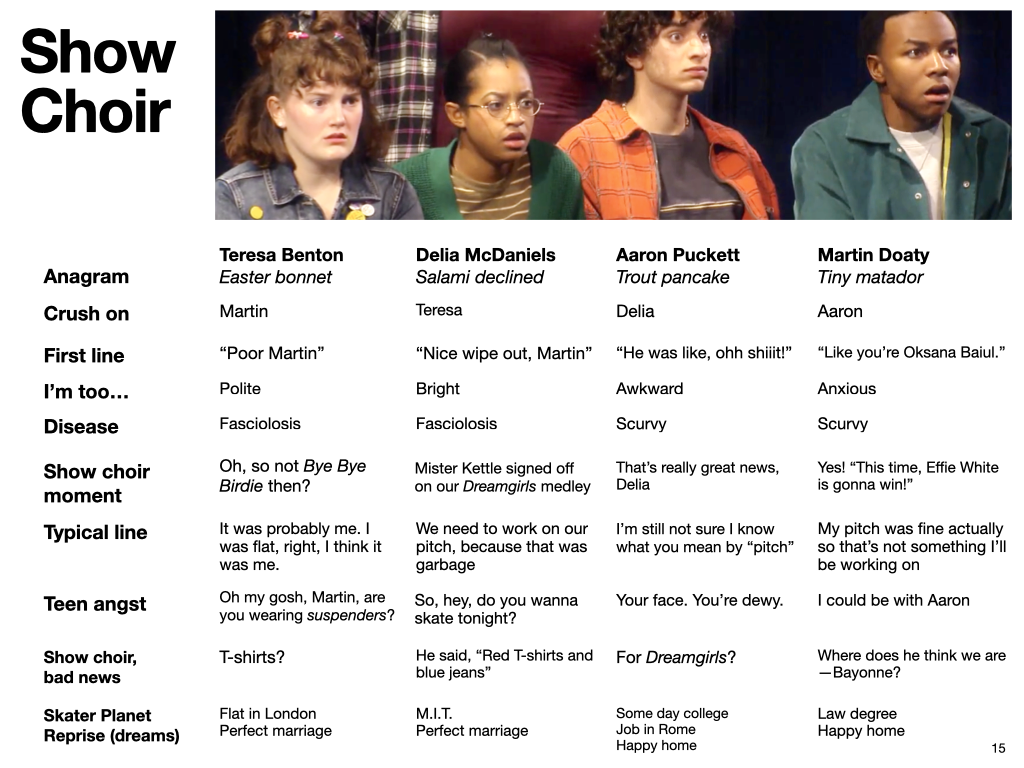
The Show Choir are defined by their crushes, their odd outsider traits, and their socially-mediated dreams—perfect marriage, happy home—which are precisely the futures Kim will not live to have. Early in Act II they reprise those dreams while she sits with them in the library playing UNO, and it lands like a blow. Tesori describes two different clocks in the show: a plot clock that starts when Kim commits to the scheme, and a deeper story clock that starts right here—the moment, over a hand of cards, when Kim truly registers how little time she has.
Look at how these teenagers use media. Their lockers, and Kim's bedroom wall, are papered with images and idols—an ambient culture of pictures and imagined selves. And note the stage grammar: all the skating happens in Act I. The frictionless rink belongs to the half of the show that still believes in escape; Act II makes them work.
From Dungeon Master to Anagrammatist
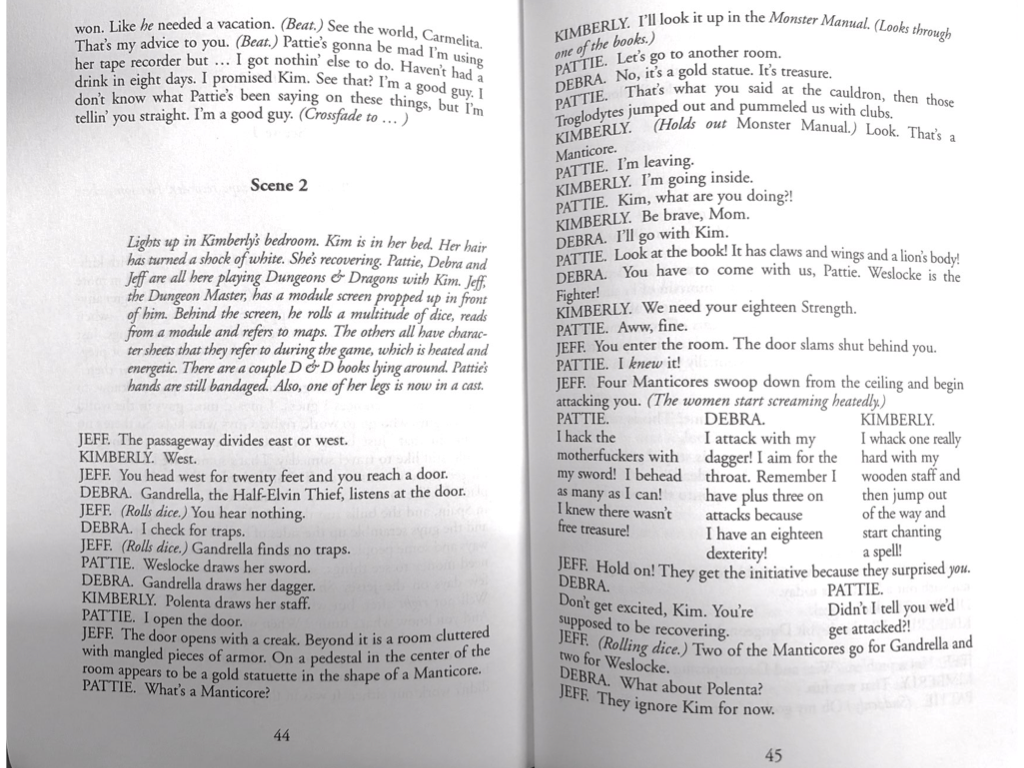
Not in the original talk—an expansion. While there were many changes between the straight play and musical, one has enormous structural consequences. In Lindsay-Abaire's original version, the teenagers do not play UNO. They play Dungeons & Dragons. The boy—named Jeff, not Seth—is the Dungeon Master: he sits behind a screen, rolls a fistful of dice, reads from a guidebook, consults maps, and narrates a dungeon into being while the others declare their moves. Debra plays “Gandrella, the Half-Elven Thief”; Pattie is a fighter; Kim is a spellcaster. The party is ambushed by manticores and, memorably, wiped out—because the Dungeon Master refuses to grant a “do over.”
Run that through Walter Ong. Tabletop role-play is a pocket of primary orality inside a literate world: knowledge performed aloud, in the moment, by a community; a world spoken into existence and never fixed on a page. Its rhythm is paratactic—and then, and then, and then—and in McLuhan's terms it runs cool: low-definition, wildly participatory, existing only because the players fill the gaps with imagination. UNO is the opposite on every axis. It tells no story. Its rules are fixed and hypotactic, a closed subordinate system you obey rather than build. It generates nothing; it only resolves.
So the musical, in swapping D&D for UNO and the Dungeon Master for the anagrammatist, quietly re-enacts the very media shift the show is about: from an oral, generative, world-building game to a literate, rule-bound, world-closing one; from a boy who speaks reality to a boy who writes it. And the play's D&D scene already rhymed with Kim's fate—a Dungeon Master who will not allow a do-over is a small god of irreversible time, which is exactly what Kim is up against. One more resonance worth naming: when Buddy objects to the game as a “Satanic” pastime that makes kids kill themselves, the play is invoking the 1980s D&D moral panic—the same recurring dread that greets every new medium, straight back to Socrates' complaint, in the Phaedrus, that writing itself would ruin the young.
Which One Are You?
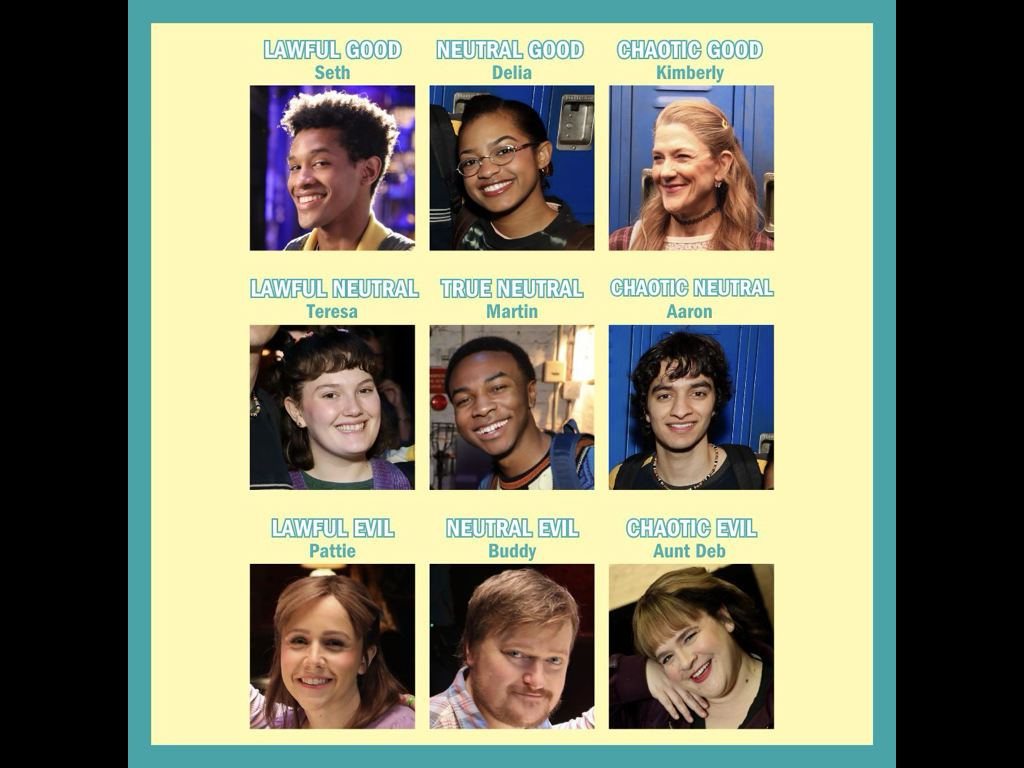
This is a piece of the show's own social-media marketing: a three-by-three grid that sorts the characters into a tidy typology—the kind of “which one are you?” matrix built to be screenshotted and shared. It is a small, telling artifact. A story about people whose inner lives are painfully out of sync with their outward selves is here selling itself back to us as a set of clean, collectible identities.
Scholars of the American musical (David Savran and colleagues, writing on Tesori and Lindsay-Abaire's earlier Shrek) have described how the contemporary musical learns to brand difference—to package the outsider as a marketable position. The grid is that logic in miniature: the hyperreal reaching out of the show and onto your feed, turning characters into avatars you can pick.
How to Wash a Check
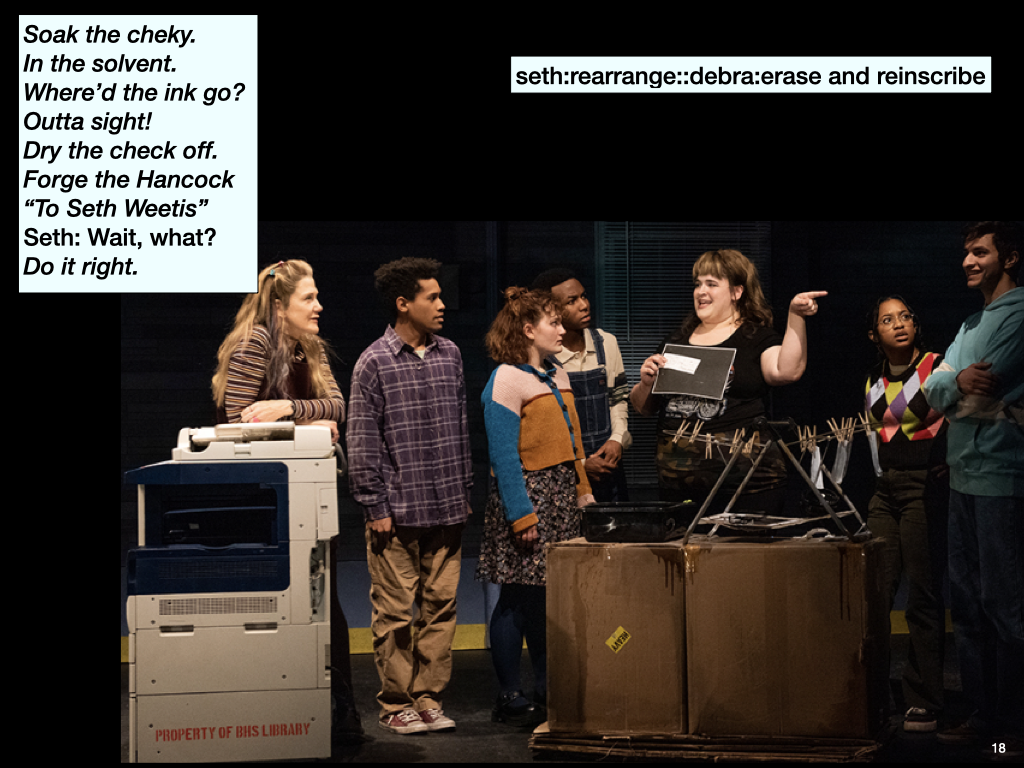
Act II opens with Debra's master class, “How to Wash a Check.” It is worth inventorying the technologies she deploys, because the number is practically a syllabus in media: the postal system, fishing line and glue traps to fish envelopes out of a mailbox, a photocopier to make a reference image, and chemical solvents to lift the ink so the check can be rewritten in Seth's name and cashed with Kim disguised as his grandmother. Every step is an operation on a document—boosting, copying, erasing, re-inscribing. The check-washing scam is identity theft rendered as literal media processing.
The staging hides a beautiful point about orality. The kids are hopeless when they try to follow linear instructions; they only succeed once they take up the task as if they were singing it, each taking a part, working as an ensemble. This is Ong's secondary orality in action—the electronic-age return of communal, performed knowing that nonetheless sits on top of the written procedure. (And watch for the stencil on the photocopier: “BHS,” Bogota High School—the last surviving trace of the town the musical erased.)
Our Disease: Lack, Excess, and the Overhead
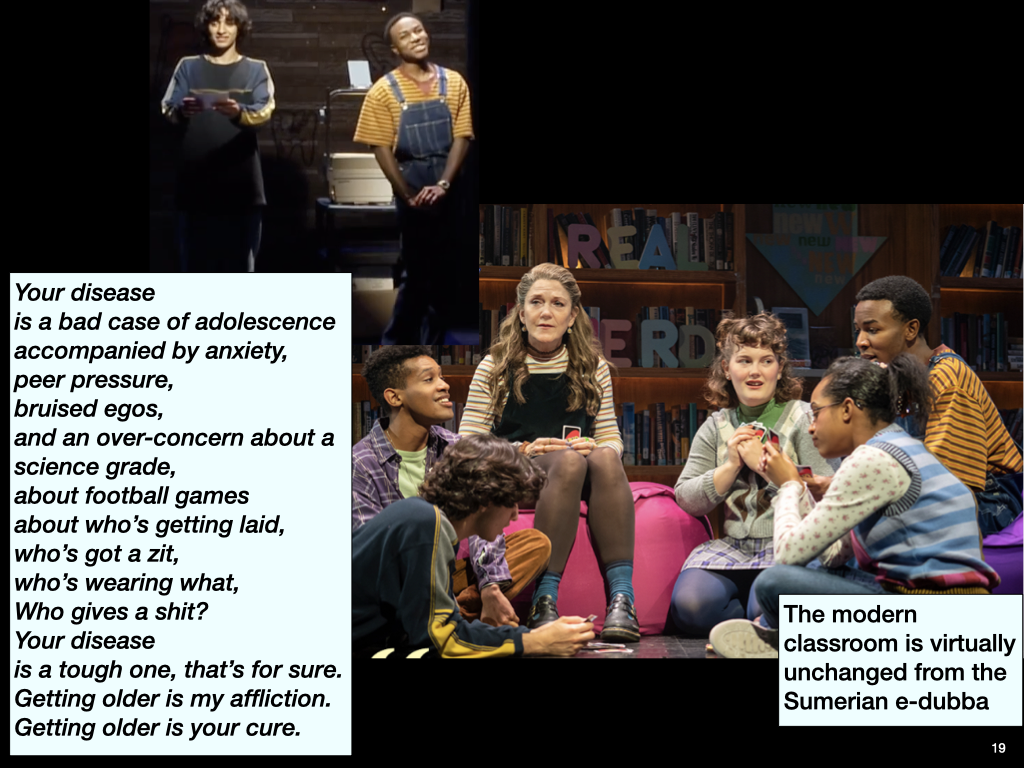
In “Our Disease,” the kids present diseases for biology class: scurvy (Aaron and Martin) and fasciolosis, a parasitic infection (Delia and Teresa). The pairing is a neat little emblem of the show's obsession with too-little and too-much: scurvy is what happens when life doesn't give you lemons; fasciolosis is what happens to Delia's father from eating watercress by the bushel. Both are conditions of the invisible—the missing vitamin, the microscopic parasite—made visible only through the mediating instruments of science.
Track the descent through media eras in this stretch. We fall from the technologically assisted fantasy of the rink (if only life had a Zamboni to resurface it), through the chemistry-set complexity of the basement, down to the genuinely antique tech of the classroom—notecards, an overhead projector, acetate transparencies. When Seth and Kim finally give their presentation, they step out from behind the overhead: they drop the apparatus and speak as themselves. And the whole scene asks us to see school as a medium in its own right—an age-appropriate filter placed between children and the world, which is another of Postman's central themes.
The Dark Night and the Disguise
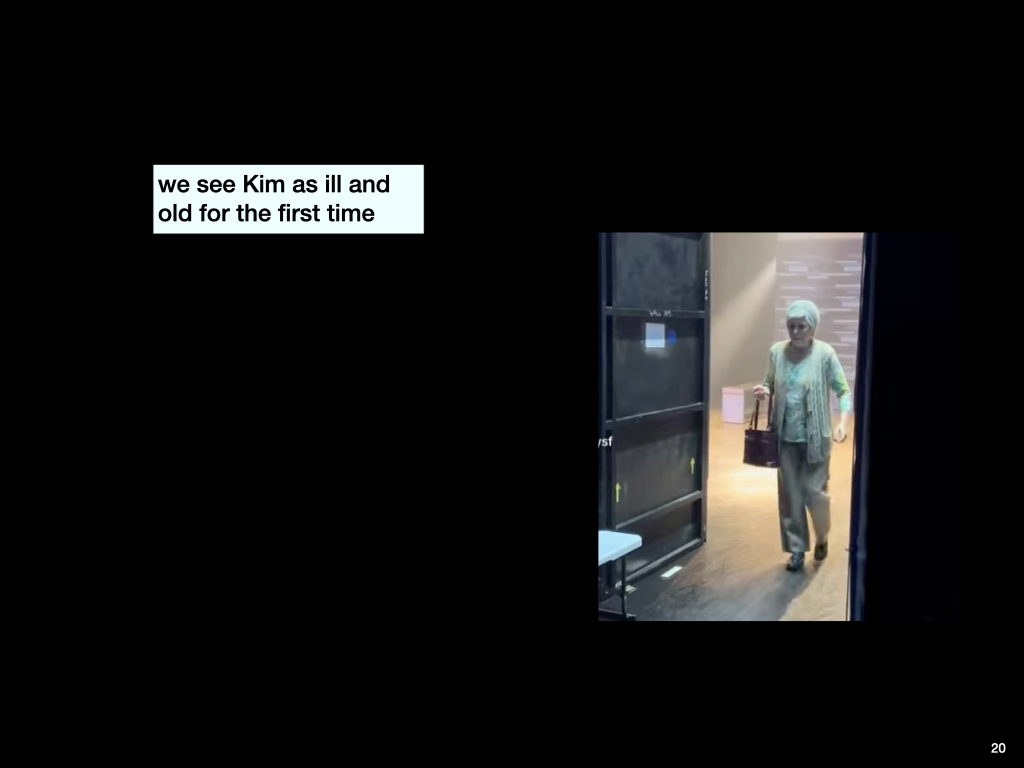
The middle of Act II is the dark night of the soul. The family secrets spill—where babies like her sister come from, how a kindly old neighbor from Lodi actually died—and Kim is forced to absorb the difficult knowledge of adulthood all at once. It sends her to the hospital. Postman's collapse becomes a plot event: the last withheld secrets fall, and with them the last of childhood.
Still set on the scheme, Kim has to impersonate Seth's grandmother to cash the checks. The disguise stages the show's deepest question as pure theatrical image. An actress in her seventies plays a sixteen-year-old who now dresses as an old woman—so which layer is the costume? When a body already reads as elderly puts on elderliness as a disguise, authenticity stops being locatable. There is no undisguised Kim to return to.
Before I Go
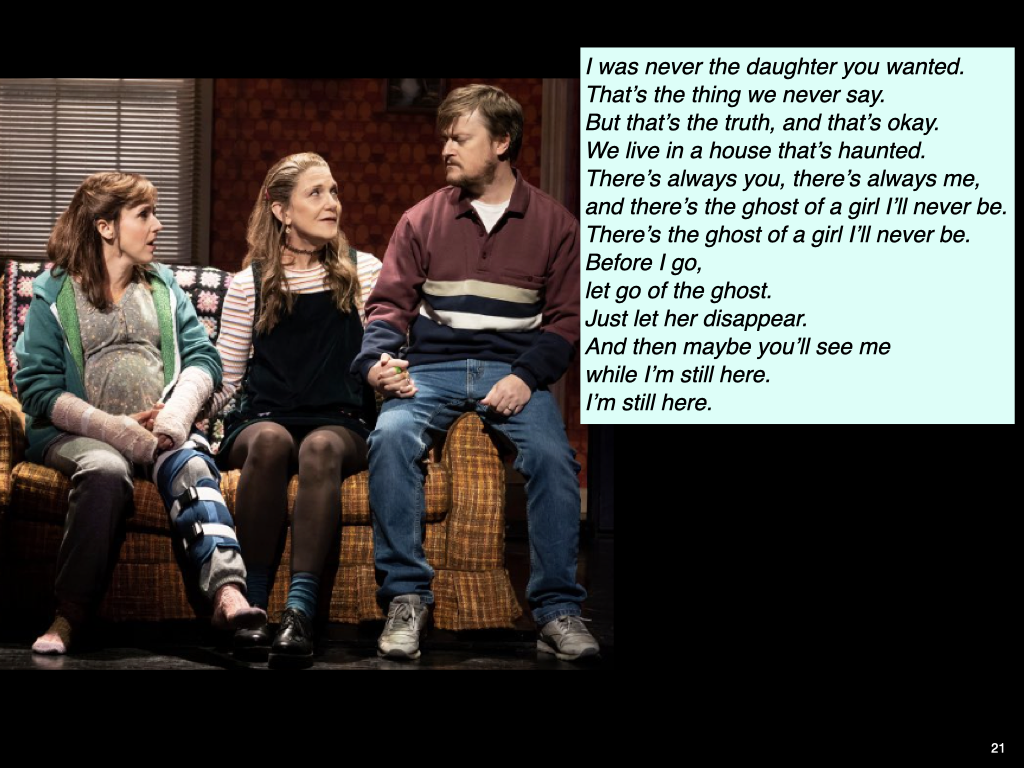
Kim's eleven o'clock number, “Before I Go,” is the emotional summit. The heist done, she comes home hoping they can still be a family, realizes they have given up on her and on themselves, and gently asks her parents to accept the reality of her life and its nearing end. What she asks for, finally, is a change of perspective—and the parents' gift, delivered in reprised fragments of their own earlier songs, is permission: to let her go and live, even briefly. The song is a farewell that is also a launch.
Great Adventure
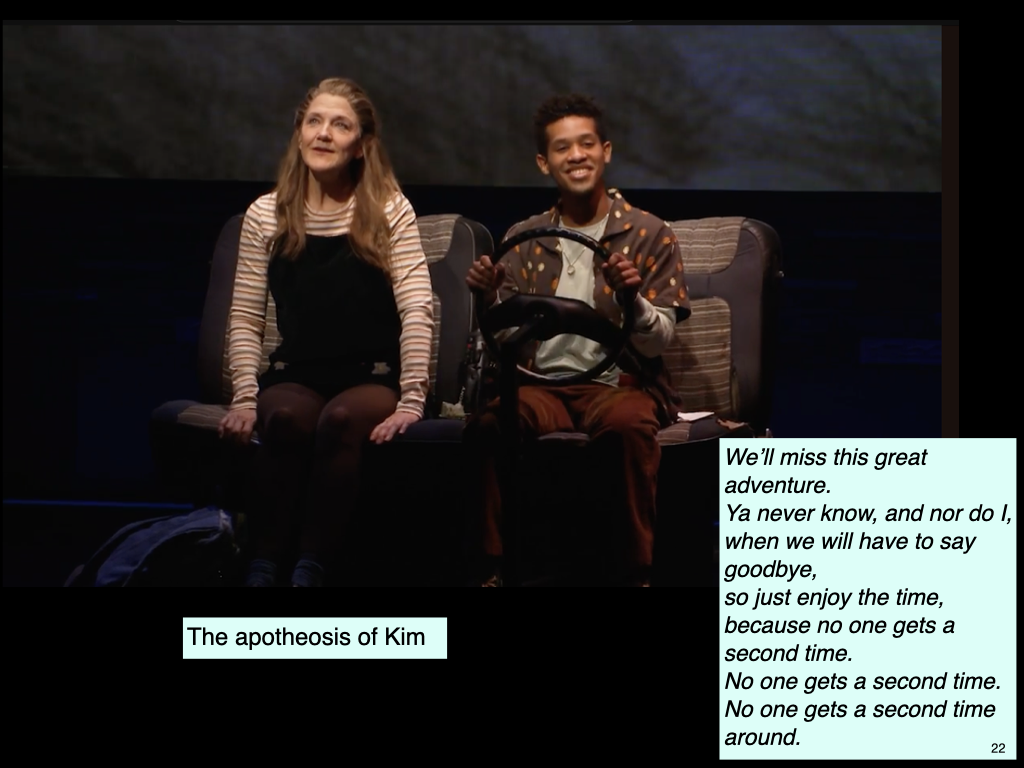
The finale, “Great Adventure,” sends everyone forward. The Show Choir get their spangly costumes; Buddy and Pattie hold baby Carmelita; Debra turns up in a Costco vest, having made her peace with honest work. Kim and Seth escape Bergen County and run the East Coast's hyperreal circuit—and this time they hold the controls: Kim has the video camera, Seth is at the wheel. The camcorder that was passed around all evening has finally reached her hands.
The hook, “Great Adventure,” names a real place—Six Flags Great Adventure, the New Jersey theme park—so even the escape route runs through manufactured wonder. (Lindsay-Abaire told Playbill the song was written as he and his wife were saying goodbye to a dying friend; its buoyancy is hard-won.) One need not spell out what Baudrillard would say about the show's last image: Kim, smiling, at Disney World—the hyperreal chosen not as a trap now but as a destination, a girl who wanted to see the world ending up at the world's most perfect copy of one.
Coda: Skaters on the Digital Planet
Put the pieces together and a pattern surfaces that the plot never states out loud. Kimberly Akimbo is built from acts of inscription and erasure: a candy-bead alphabet and a misspelled genome; anagrams and washed checks; camcorders, disposable cameras, Game Boys, overhead acetates, and photocopiers, an entire late-analog toolkit for recording and rewriting the self. Its geography is a chain of Baudrillardian simulations from the rink to Disney World. And its central adaptation choice—trading the play's Dungeon Master and his spoken, generative campaign for a boy who makes anagrams and a game of UNO—quietly performs the move from orality to literacy, and from a world you build together to one handed to you finished.
Here is the sharpest turn of the screw, and the reason the show rewards a media ecologist. A Broadway musical is itself a machine for direct address: the song is an interiority dump, a character stepping to the lip of the stage to tell you exactly how she feels. The play revealed its people sideways, through what they did—most of all through a role-playing game. The musical, gaining the power to state feeling outright, gives up the older art of showing it indirectly. Lindsay-Abaire is quoted in Blumenthal Arts as saying a song lets you reach an audience's emotions “more directly” than a play can. So the adaptation does not merely depict the compression of experience by media—it enacts it. That is the deepest reason to see Kimberly Akimbo: a show that is, without ever announcing it, about the medium it is made of.
Sources & Credits
The works. David Lindsay-Abaire, Kimberly Akimbo (play; Dramatists Play Service, 2003; world premiere South Coast Repertory, 2001; New York, Manhattan Theatre Club, 2003). Kimberly Akimbo (musical), book and lyrics by David Lindsay-Abaire, music by Jeanine Tesori (Atlantic Theater Company, 2021; Broadway, 2022). Official web site.
Interviews & production sources. Tesori and Lindsay-Abaire's song-by-song commentary (Playbill, 2023); the creators on adapting play to musical (Broadway.com; Blumenthal Arts); Stuart Miller, “David Lindsay-Abaire's Working-Class Women” (American Theatre, 2023); Atlantic Theater Company study guide.
Theory. Marshall McLuhan, Understanding Media (1964); Neil Postman, The Disappearance of Childhood (1982) and Amusing Ourselves to Death (1985); Walter J. Ong, Orality and Literacy (1982); Jean Baudrillard, Simulacra and Simulation (1981). On the contemporary musical and the branding of difference, David Savran et al., “‘Let Our Freak Flags Fly’: Shrek the Musical and the Branding of Diversity” (Theatre Journal, 2010).
Images. Slides reproduce production photography from the Broadway staging (principal production photographer Joan Marcus) and the show's promotional materials, presented here for scholarly commentary and criticism. The spotlight image is a page from the published play (Dramatists Play Service edition).