Journey To Mars
Writing this album began on the evening of Friday, October 25, 2019 in a hotel room at the Doubletree in Columbus, Ohio. I had just arrived for the Ohio Valley Filk Fest, one of the major yearly conventions for science fiction and fantasy-flavored folk music, and immediately signed up for the "Iron Filker" contest.
Each year at OVFF, there are two songwriting contests: the first, announced months ahead of time, asks for songs written to a theme (in 2019, that theme was "Music is the universal language," and I had that song in hand when I arrived). For the second, the "Iron Filker," the theme is distributed on Friday night, and songs have to be written and performed by Sunday afternoon.
I actually enjoy the challenge of this kind of writing exercise; I've always been a fan of the late Harlan Ellison's ability to crank out a short story in a few hours sitting at a typewriter in a bookstore window. Constraints can be enabling, and the idea of a time-boxed writing assignment is a creativity booster. So, after picking up my badge, doing the happy round of hellos and hugs, followed by a brief visit to the first-night filk circle, I settled in to consider the prompt: "Lost in translation."
These days, I write most first drafts of songs electronically, using a delightfully tiny Sony ICD UX-533 digital recorder to capture phrases and quick sonic sketches, and the Google Keep iPad app for brainstorming and refining lyrics. What follows is the Keep transcript in the left column, with annotations in the right. I haven't edited anything that appears, so, yeah, some of it's a bit cringey.
FYI — There was stiff competition at the 2019 Iron Filker. This song didn't even place.
Scroll all the way down for the audio development, showing the evolution from the raw Columbus recording all the way through to finished product.
My first idea came in the form of a rhythmic reading of the title, stretching out the word "lost." This felt like it would make a good repetitive element, and I imagined singing it against a 3-chord strumming pattern. I immediately put my Kyser partial capo on and tried the chords out. Felt good, but I wasn't ready for melody yet.
I started right out thinking about technologies of "translation," and began brainstorming. Part of the challenge in a songwriting contest is to pick a direction you think will be different, so I began casting about for non-linguistic metaphors. Almost immediately, I came to the end-of-verse hook, with a line leading into "lost in translation." I immediately locked that in.
Replicants. This bit of exploration went nowhere, but out of it came the kernel of the verse structure: descriptions of problematic notions, with a shifting focus from verse to verse — a sort of running catalog of things, systems, and processes that were lost in translation.
Livin in a cave. These are the first lines that survived all the way to final. By this point, I was beginning to zero in on a verse structure.
The first take is how it came out as I was riffing; edits appear after the slashes. Some were immediate, some came over the next day. When I'm trying to capture a draft at this generative phase, I tend not to go back, but rather try to keep pushing forward. Editing at the point of utterance kills spontaneity; it's all about the "Yes, and..."
Forest. There are a couple of "forest" metaphors on the album, but it didn't survive in this song. However, I did begin to see the triad of human perceptual issues (ontology, epistemology, phenomenology) as a frame for the early verses.
Phenomenology. I knew I wanted to keep phenomenology, so I tried working backwards: what would get me to that? It occurred to me to slip in one of Marshall McLuhan's famous sayings: "Fish aren't aware of water."
Planck length. Tried another approach to picking up the uncertainties inherent in contemporary physics. By this point, it was after midnight, and I was just grinding metal.
In these writing situations, I find that my subconscious will pick up on the work I'm doing, especially if I can load it up with a basic rhythm and some lyrical beats to hit. So I crashed.
Woke up with an entire bridge, melody, words and all, running in my head. I grabbed the iPad and started typing madly. Most of this survived to final exactly as my subconscious created it. This doesn't happen for me often, but when it does, I usually don't tamper with the stuff that comes out. I think about Rilke, standing on the cliffs at Duino Castle, hearing the Elegies come howling at him out of the Wind, and just write it down.
Fox. This line suggested to me that a fruitful direction for at least some verses might be our current mediated political reality. I was snarkily happy with the double-entendre, so I capitalized "Fox." Fools became "tools" in final to avoid repeating it from the bridge.
Chopra was a misstep; by the time I got to the end of the verse I knew the right way to fill this in — an immediate loop-back and edit.
Anti-vaxxers. While I didn't know how long the song was going to be, I knew it was likely to need another "bridge." Technically, I was writing this as a "chorus," because the Iron Filker requirement is "three verses and a chorus." It took a while to circle back and drop in "botnet."
Bishop. Most of this verse survived all the way to final. By now I was on a roll, and was casting about for cultural phenomena that suffered from "translation" issues. I immediately went for the disjunction between the Catholic church's doctrine and their less-than-stellar response to a history of sexual abuse.
Any answers. This verse popped up, but felt like it was at a different level of abstraction. That was okay; I knew it would fit somewhere.
Amused ourselves to death. Continuing with the higher level of abstraction, this immediately felt like it was going to end up near the tail end of the song. I packed a lot of stuff in here: Neil Postman (Amusing Ourselves To Death), Marshall McLuhan (his Mechanical Bride was a 1951 study of advertising that prefigured many of the ideas in Understanding Media), Jean Baudrillard's theory that simulations come to precede reality, Deleuze and Guattari's rhizomes.
Acolytes. I had taken a break to grab breakfast, and when I came back to the room, this verse came out. Almost immediately, I went back and adjusted the first lines; that was the most satisfying feeling of the entire weekend: the buttered/shutters couplet was, for me, one of those high "Fuck, yeah" moments. Every once in a while you get a couplet like that and you feel like you really nailed it.
Clouds. Almost nothing survived from this verse, but I really loved the image of "the handmaids at the state house," which was a really powerful protest tactic at many state capitals, Providence included.
The Batfrog at Doubletree Columbus
Prisoner's dilemma. I was getting ready to head down to the con, and this one came to me as I was taking a shower.
I was in between sessions at the con and came back to my room for a quick break and writing session. Most of it was editing the prior verses. By this point, I was also pretty sure of the chord progression for both verse and chorus and I ran through what I had. Still didn't record it; wasn't quite set enough for that.
This was a complete rebuild of the early effort to talk about physics.
I started out using Bose-Einstein condensation as emblematic of uncertainty; that's the way I performed it at the con. The change to quantum gravity came much later. The "is, are" turn was another of those happy moments.
Mute capitulation. Wasn't exactly sure where this verse tag was going to go in the song, but it felt like a usable building block.
I hadn't decided on verse order yet, but this came out as I was playing through what I had, and it was pretty clear that it belonged in the second "bucket" of content: First section was philosophy, then the chorus, then the political and social verses, then the second chorus, and finally the higher-level abstractions.
I remember spending a lot of time just playing through what I had, and looking for the seams, patterns, points of connection to try to find the best order to put things in. I knew I had enough material; I was just looking for the right sequence.
I went down to breakfast early with my iPad and grabbed a table away from everybody else. I had two cups of coffee and started re-arranging things. I copied all the verses to the bottom of my Google Keep file and moved them around until they felt right.
About 10am, I set up the iPad next to the public computer in the lobby, retyped everything into a Word document, and printed out copies to distribute to the judges.
Then, I went back to my room, spread the printout on the bed, and played through the whole thing into the digital recorder. Here's that sound file, with authentic Doubletree room tone. I didn't notice the repetition of "capitulation" in two successive verses; that's the kind of mistake that slips through a first draft written this quickly with too much caffeine and not enough sleep.
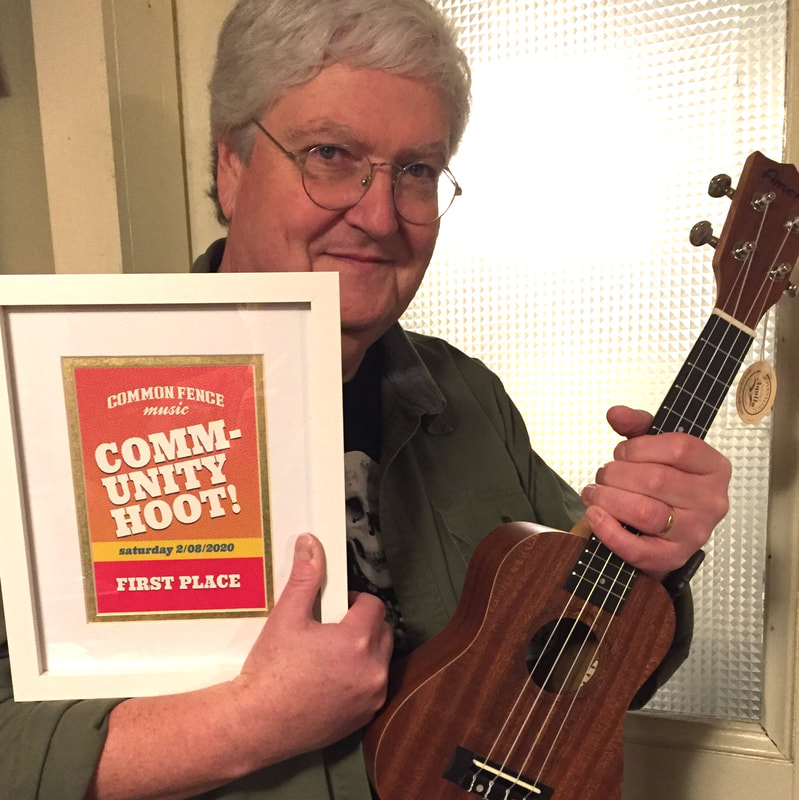
With first place ukulele
By February, I had an idea of putting together an album. On Feb 8, I won the Common Fence Music Community Hoot against acts from around RI, largely, I suspected, on the strength of "Lost In Translation." I promised I'd write a ukulele tune (which ended up being "Walking Off The Earth.")
I thought at the time the album was going to be like the one I had done in 2019: recorded in my basement, in GarageBand, so I hacked together a demo version. It is, as they say, loose.
During "February Album Writing Month," or FAWM, I cranked out a bunch of new material, and began to have a sense of what might fit together on an album: Feb 1: Sigmund Freud's 115th Dream Feb 2: Down To The River Feb 5: Trail Of Mars Feb 16: Into Thin Air (originally "Just Barely There," the theme for the March, 2020 Rhode Island Songwriters Association "Songwriters In The Round" show. Feb 26: Walking Off The Earth
In March, as we all know, things went sideways. I played "Just Barely There" at the RISA show at AS220 in Providence on March 11, just before the world shut down. At this point, I started noodling with the idea of reaching out to artists I knew who were being impacted by the lockdown. I had money saved in the bank earmarked for attending conventions—which, even in March, I could predict were going to be canceled for the foreseeable future.
I still didn't have a name for the album, but I put together the demo versions I had and reached out to A.D. Puchalski, a comix/graphic artist I really admired. She had done illustrations for a piece I wrote for WWIII Illustrated years ago, and I just loved the look and feel of her work.
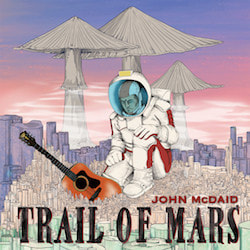
She listened to the early demos and came back with some amazing sketches, one of which really stood out, an early iteration of the astronaut and guitar. That locked in the title for me: Trail Of Mars. The final graphic, which she sent on April 2, was just so gorgeous I knew I needed to bring the rest of the album up a notch to match it.
So I rewrote lyrics, played around with order, and thought about how to make this a more professional project. And in May, I set up a call with Ellis Paul to talk it over. I'd been attending the New England Songwriters Workshop that he and Laurie MacAllister run every Labor Day in Connecticut, and I knew he'd have some good insights and suggestions.
And he did. Over a couple of Skype meetings, he pointed me in the right direction (get a real microphone; work with a pro engineer, engage top-notch session musicians) and offered powerful revision pointers on a couple of the songs (Down To The River, Into Thin Air). I took most of his suggestions; any lyrical missteps that remain are purely my responsibility.
So I called up Mark Dann, who had recorded, mixed, and mastered Ellis's last album and who, fortuitously, I had once worked with back in my time in New York when I had recorded with Bill Bly of Left Field. He actually remembered working with me and was interested in taking on the project. He reiterated advice on buying a high-end microphone, so I got the best one I could afford, a Shure SM7B, and sent him a test. After some tweaks (leaving enough space at the beginning of the track in GarageBand, recording both mic and DI versions of the acoustic guitar) he was ready for me to start tracking. Here's the absolutely terrible sounding May 20 click track (GarageBand won't output the actual metronome, so you end up looping a drum track for reference, which is what you hear.) And here's what came back, the basic vocal and guitar mix. You can hear spots where I drifted off tempo and Mark has pulled me back onto the beat; absolutely critical when you're going to layer stuff on top of it, especially remotely.
Mark suggested an absolutely amazing drummer he knew from NY, Eric Parker, who had played with folks like Joe Cocker and Lou Reed. And he was willing to work on the album. So on June 7, over Facetime and a cool online ProTools connection, I was sitting in Rhode Island monitoring in real time as Eric laid down drum tracks. He had listened to the guitar mix, and came super prepared, with really tasty ideas for every song; I don't think we ended up recording more than two takes of anything. By the next day, Mark had mixed it in.
I'd already been reaching out to the folx who'd been teaching at the New England Songwriters Retreat. Both because I knew them (at least, slightly) and because they were amazing musicians that I wanted to support during a time when every live music venue had been forced to shut down. I was amazed and grateful when they all said yes. I was totally overwhelmed by the lineup: Abbie Gardner's dobro and vocals, Craig Akin's bass, Tracy Grammer's violin and vocals, Jim Henry's electric guitar and mandolin, and Laurie MacAllister's vocal. This was more than I could have hoped for.
Craig Akin was up next, laying down bass against what was now the guitar, vocal, and drum track. Here's the brilliant bass part incorporated into a June 16 mix.
For "Lost In Translation," I wanted a cool electric guitar part, and Jim Henry came up with some absolutely mindblowing stuff. Here's the raw material from a July 7 take before the mixdown. The balance is weird, but you can hear all Jim's cool EBow effects.
And this is Mark Dann's rough mix with everything as of July 9. For anyone who doubts that mixing and mastering is an artform comprising unique skills and high-level musicianship, this is presented as a counterexample.
Music video
Finally, in the spirit of finis coronat opus, here's how the final release version sounds with the music video.
Official music video for "Lost In Translation"