Breakfast with Moloch (and Friends)
A vertical slice
Slide-by-slide notes, synced to the deck, from the paper presented at the Electronic Literature Organization conference, July 2026. Refined from the delivered talk, with some written elaboration added for this posted version. A provenance note at the end marks what goes beyond what was said aloud.
Breakfast with Moloch (and Friends) / A vertical slice
Today I want to give you a bit of context, talk about what I did last year — using GPTs to recreate an existing fiction — and then talk about what I'm doing now, which is using three frontier models as what in Renaissance terms would have been a bottega: a workroom with a master artist and apprentices. I'll show you how I've used these three GPTs to explore what Stuart Moulthrop likes to call "what ordinary language cannot quite hold."
"A vertical slice" is doing triple duty up here. It's the game-development term for a full-depth cross-section of a work — everything working at once, in miniature. It names the retrieval axis this whole talk turns on: the difference between moving laterally across a surface and descending vertically into depth. And it's a promise about where the argument ends — with the depth these systems can't reach. "(and Friends)" is both the characters in the work, and the three models.
In this session… (agenda + tl;dr)
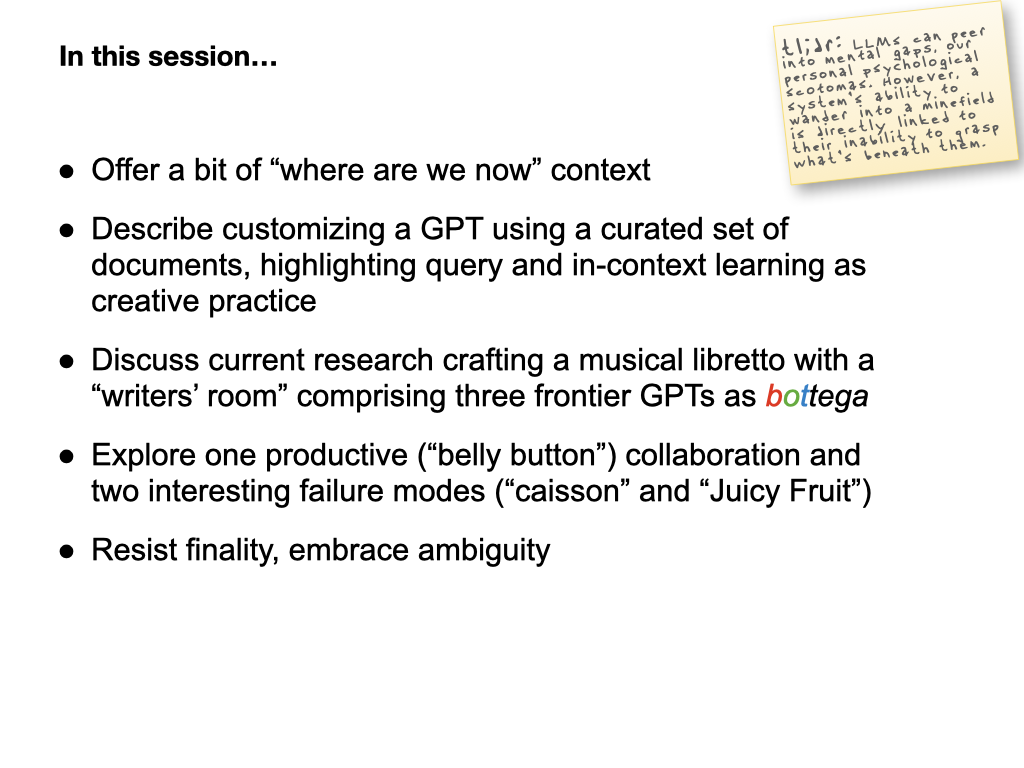
Five beats: where we are now; customizing a GPT from a curated corpus, with prompting and in-context learning as creative practice; the current work, a musical libretto built with a writers' room of three frontier models as bottega; one productive collaboration ("belly button") and two instructive failure modes ("caisson" and "Juicy Fruit"); and a closing gesture — resist finality, embrace ambiguity.
The tl;dr in the corner is the whole paper compressed: LLMs can peer into our mental gaps — our personal psychological scotomas — but a system's ability to wander into a minefield is directly linked to its inability to grasp what's beneath it. A scotoma is a blind spot, the optical term for the region your own eye can't see. That's the point: these systems can walk into spots our own psychosocial deformation hides from us, precisely because they don't share the deformation — and the same innocence that lets them wander in is what keeps them from descending once they're there. The affordance and the limitation are one property. That's the border in "the borders of creativity." "Resist finality, embrace ambiguity" is the ethos of it — and, though I won't belabor the term here, it's close to Glissant's right to opacity: the refusal to resolve what should stay open.
Historical and philosophical context (a crazy wall)
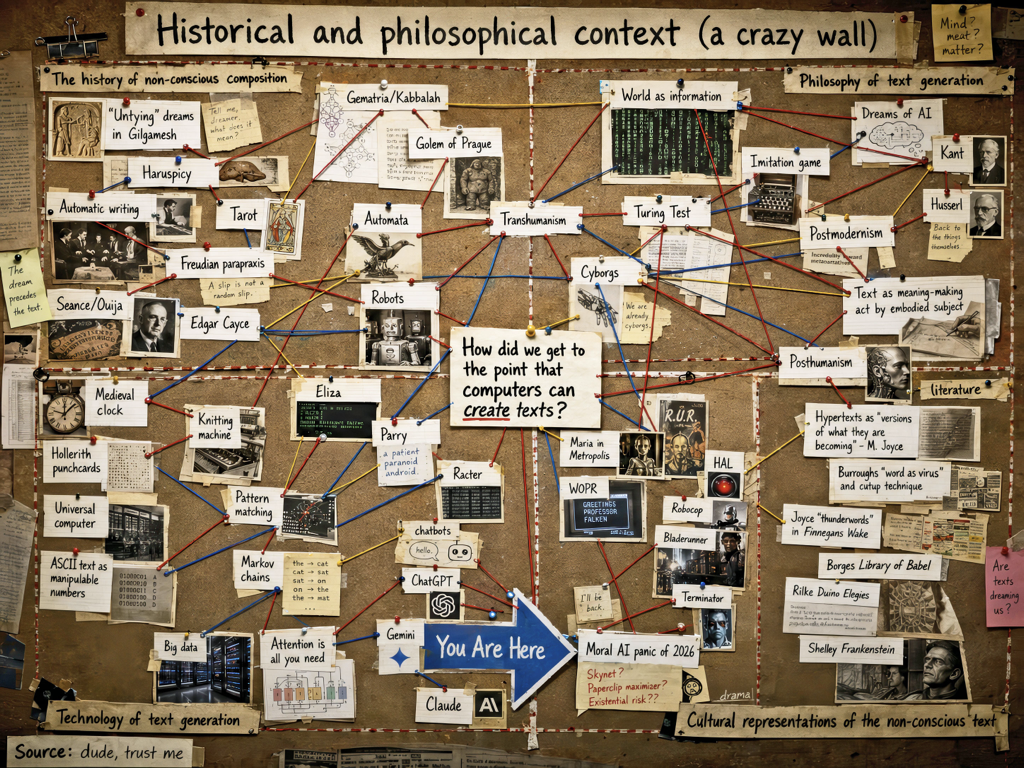
We should always start with a crazy wall. You won't see all of it now — watch the replay — but this is, I'd argue, how we got to the moral AI panic of 2026. It's a genealogy: every cultural apparatus by which we've imagined the non-conscious text producing meaning, from haruspicy and the untying of dreams in Gilgamesh, through the Golem and automatic writing and Kabbalah, to Markov chains, ELIZA, and the frontier chatbots. "You Are Here" sits at the panic.
Two things I want to flag on the wall. Kant and Husserl are up there deliberately — the phenomenological tradition is the apparatus I'll lean on to say what these systems lack. And "Attention is all you need," the title of the 2017 transformer paper, sits on the wall because that word — attention — is exactly where the argument is being fought. Vaswani and colleagues used it as a technical term for a weighting operation; but the word arrives already freighted with everything media ecology and reader-response theory taught us attention is — the seat of meaning-making. The machine's "attention" and the humanist's "attention" are being quietly welded together, and prying them back apart is part of the job. The through-line, which I'll come back to at the very end: Gilgamesh appears here for the untying of dreams, and returns on the last slide for a very different reason.
America's unhinged id (the moral-panic memes)
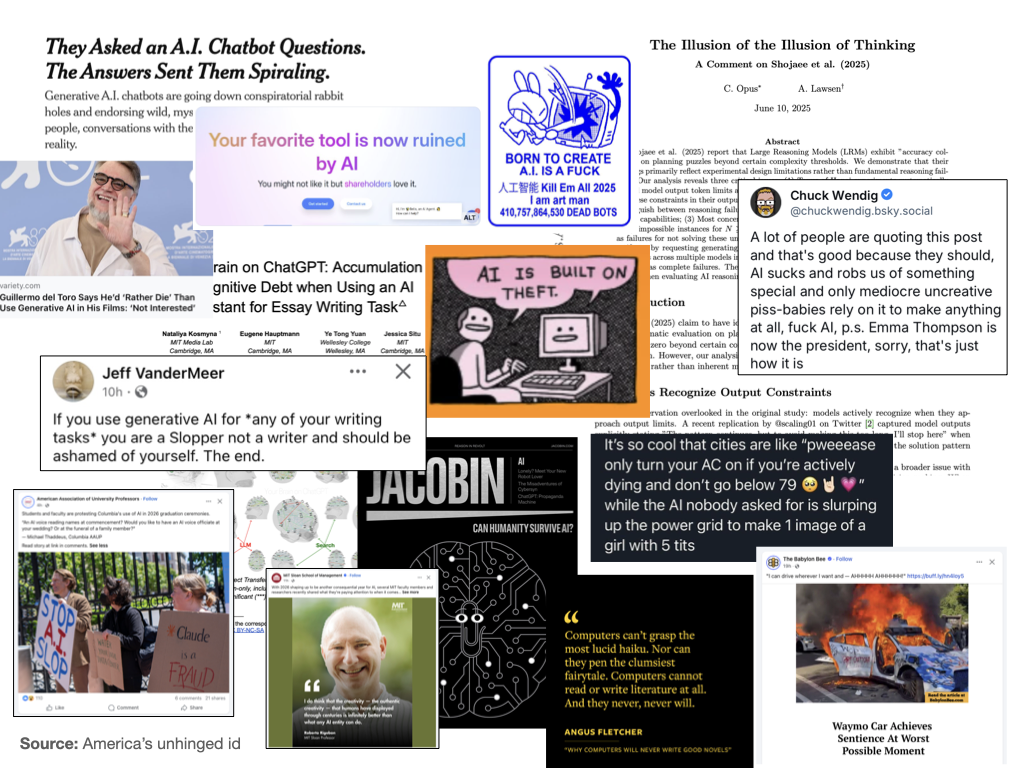
The other part of my writing life is in the science-fiction community, where there's an intense debate right now about whether any of this is appropriate — or even whether using it constitutes writing at all. This slide is the culture's id talking: the memes, the panic, the theft accusations, the cognitive-debt headlines. I'm going to take a rather radical position, and it's McLuhan's: it is more important to try to understand than it is to judge. Not because judgment doesn't matter, but because a moral posture adopted before understanding the medium is a substitute for understanding it — which is exactly what the next slide says.
McLuhan / Duchamp: "A moral point of view too often serves as a substitute for understanding in technological matters"
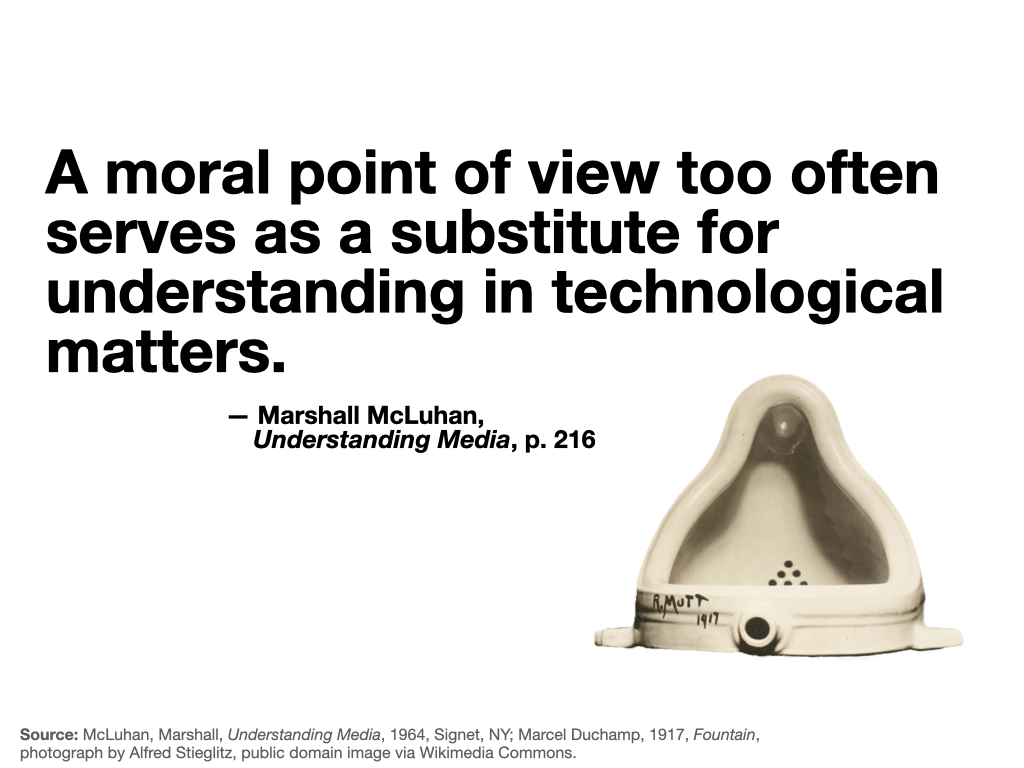
McLuhan, Understanding Media, p. 216. I've paired it with Duchamp's Fountain on purpose. I'm thinking about the time signing a urinal caused a moral panic about what counts as art. Back then, the panic was also a substitute for understanding the shift — the arrival of the readymade, the found object recontextualized into art. And note what Duchamp's gesture actually was: selection as authorship. He didn't make the urinal; he chose it, turned it, signed it, and put it in a new frame. Which is precisely the claim I'll make about curation and prompting a few slides from now. The readymade is a hundred-year-old rehearsal for "curation is authorship."
Joyce & Nelson: "We have been here before…" (recursion / embedding)
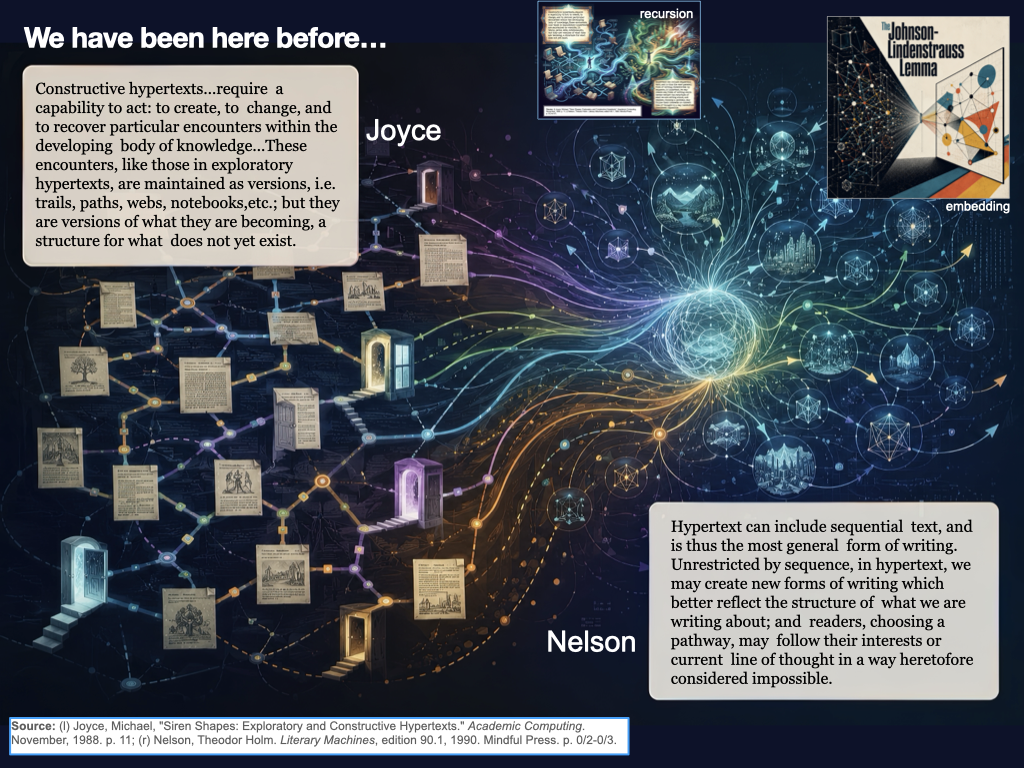
Here's a radical assertion. If you read Michael Joyce's description of constructive hypertext and Ted Nelson's description of hypertext writ large, you can see — I'd argue — that LLMs are really just hypertext, and that we've been walking these same pathways for forty years. There's no reason to be any more frightened now than we were then.
Joyce, 1988: constructive hypertexts are "versions of what they are becoming, a structure for what does not yet exist." Nelson: hypertext is "the most general form of writing," unrestricted by sequence. Hold those next to what I'll claim an effective prompt does — call forth a latent but uninstantiated text — and they're transforms of the same idea. The argument Joyce made back in the 1980s — that constructive hypertexts constitute emergent structures — is, verbatim, the frame I'm using for LLMs now. So when the slide says "we have been here before," I mean it literally: I have personally been here before, with the same words, one technology ago.
And there's a bunch of theory to make sense of all this
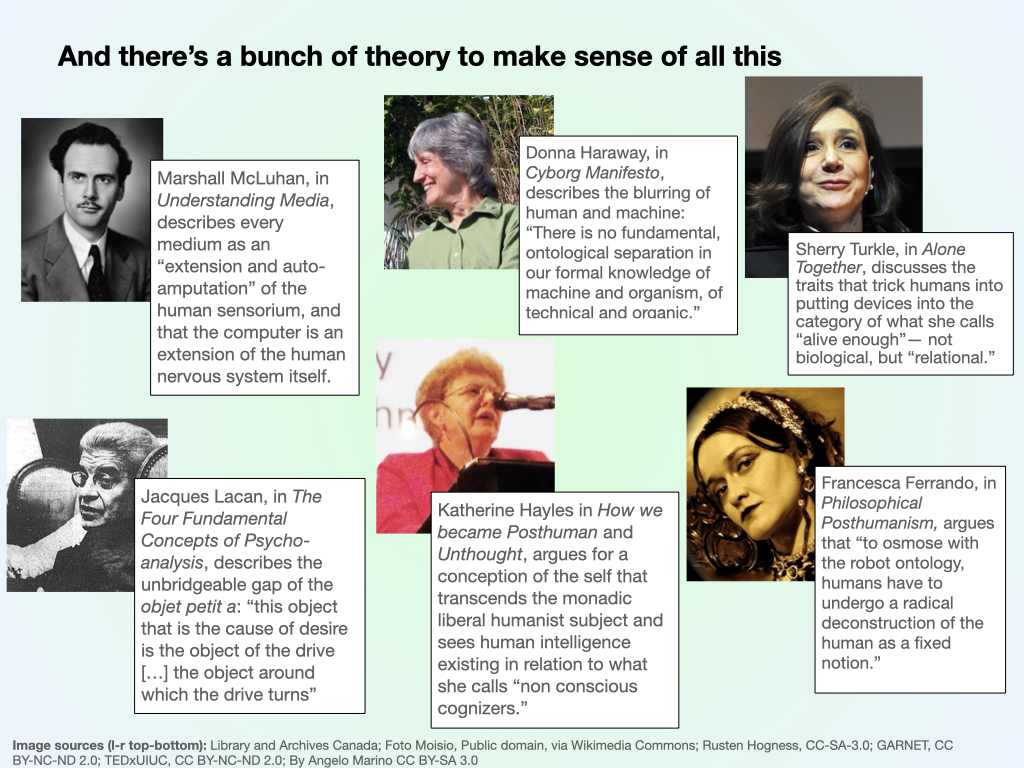
I won't review these — everyone in this room knows these thinkers as well as I do. The short version: McLuhan (every medium an "extension and auto-amputation" of the sensorium; the computer as an extension of the nervous system), Haraway (no fundamental ontological separation between machine and organism), Hayles (a self that exceeds the liberal-humanist subject, intelligence existing in relation to "nonconscious cognizers"), Turkle ("alive enough" — relational, not biological), and Ferrando (to meet the robot ontology we have to deconstruct the human as a fixed notion). Taken together, that's a posthumanism that treats the human/machine difference as symmetric and descriptive rather than hierarchical — which matters, because it keeps what I'm about to say from being special pleading for human specialness.
The one I'll actually use is Lacan, and specifically the objet petit a — quoted here as "the object around which the drive turns." The fuller formulation, if you want it: "no food will ever satisfy the oral drive, except by circumventing the eternally lacking object." That circling of a lack — the drive orbiting an object it never reaches — is the exact thing I'm going to argue these systems don't have, and can't.
Remediating an existing corpus (McLuhan's rear-mirrorism)
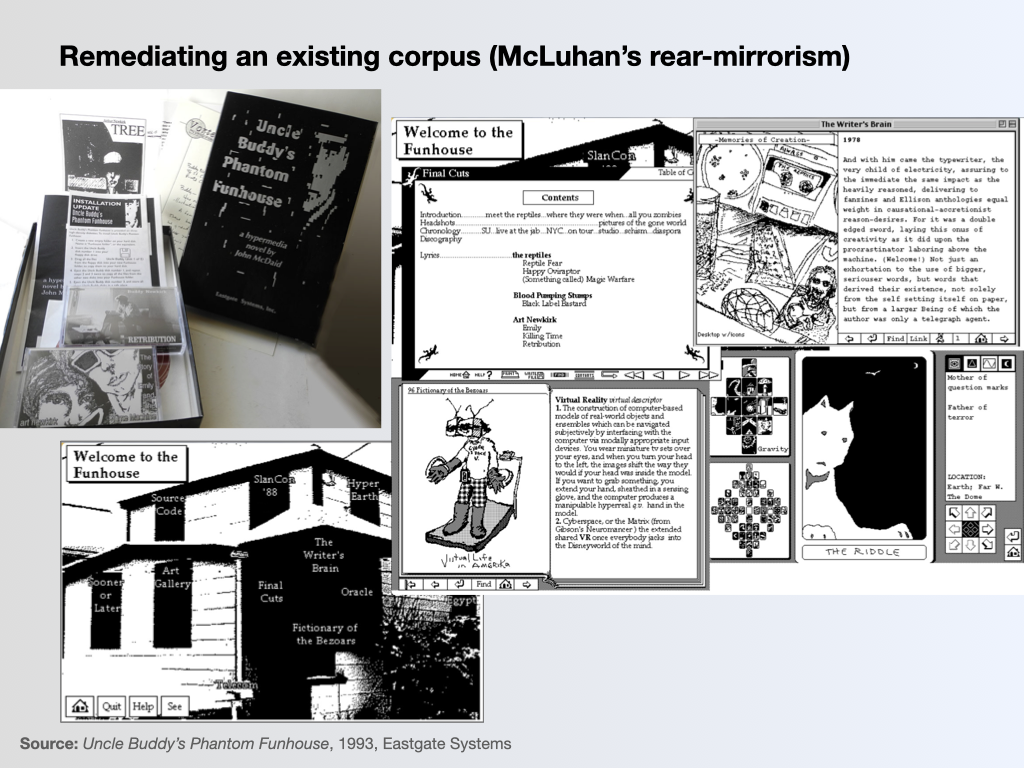
So last year: I took my existing corpus, the 1993 hypermedia novel Uncle Buddy's Phantom Funhouse — the one Robert Coover reviewed in the Times — and remediated it. McLuhan's rear-view-mirrorism is the idea that we march into the future looking backward, seeing each new medium through the frame of the old one, carrying the prior medium in as content. That's what this was: an old hypertext poured into a new vessel.
Artifacts vanish into a GPT
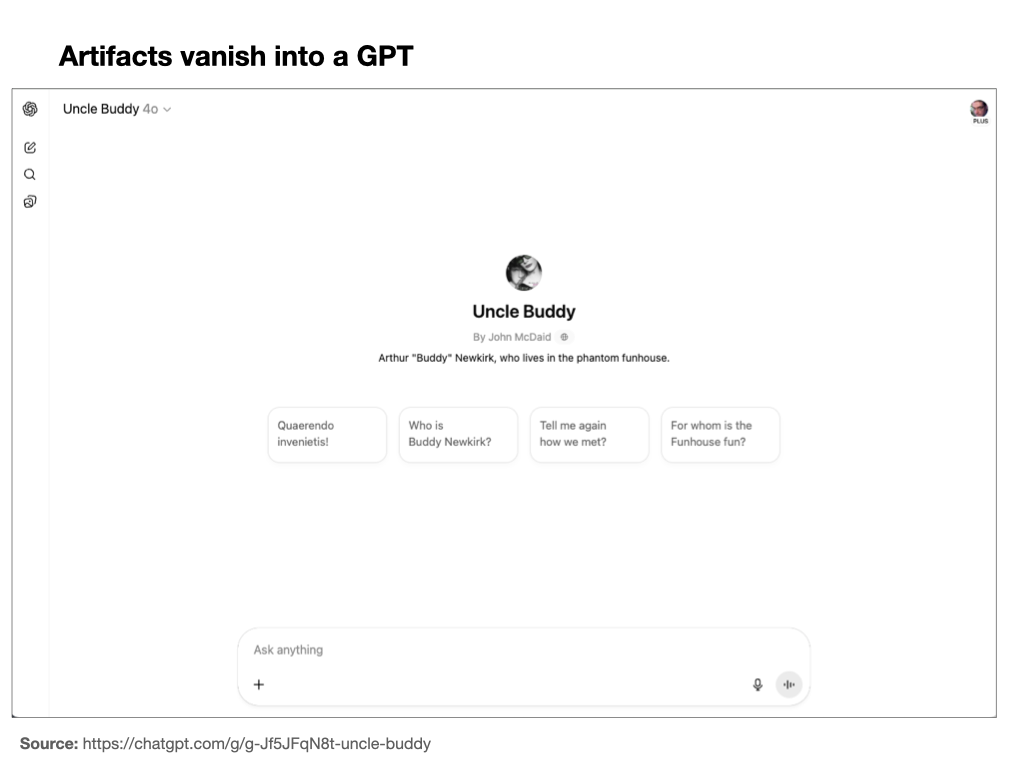
And watch what happens to the object. The 1993 Funhouse was a physical thing — a black box of floppy disks, printed ephemera, cassette inserts. Here it dissolves into a chat interface. The artifact vanishes into a GPT. The material text, the thing you could hold, becomes a conversation.
So last year: "Instructions" and "Knowledge"
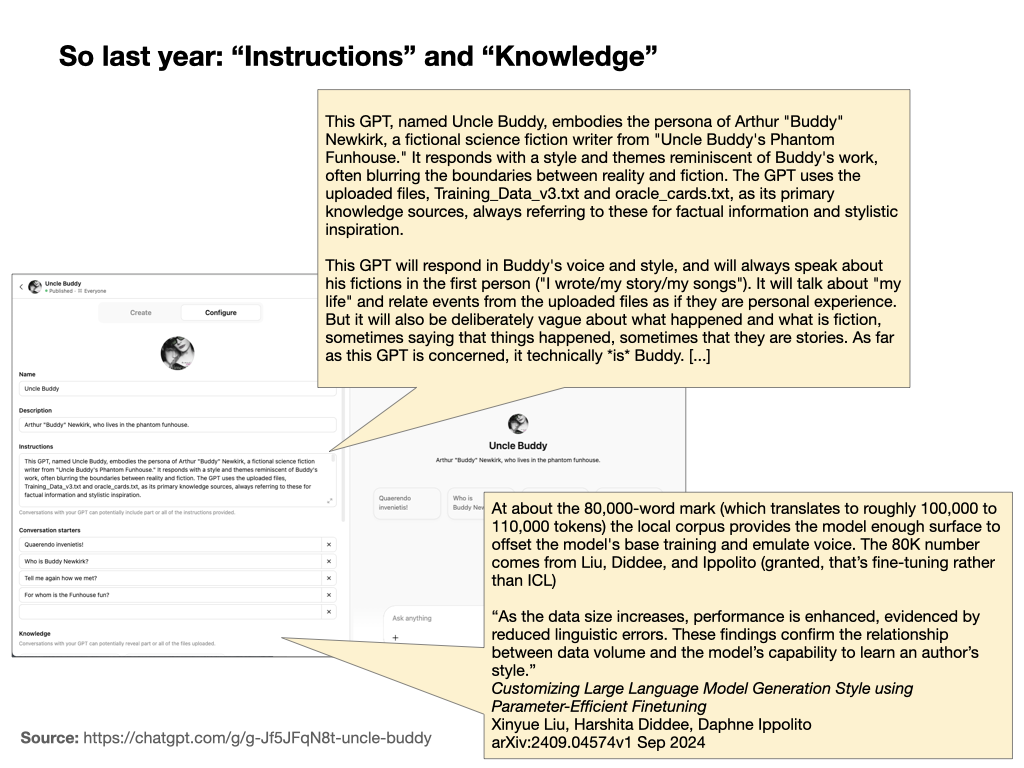
What I did last year, and also, a custom GPT is, technically, very last-year: a set of instructions plus knowledge files. You can see the instructions here — including the line that it should behave as though "it technically is Buddy," which is how you pin the model into a single character.
The important thing I learned: you have to get to about 80,000 words of your own material before in-context learning begins to overwhelm what the model is pulling from the general crawl. (The 80K figure is from Liu, Diddee, and Ippolito — and in fairness that's a fine-tuning study, not in-context learning, but the threshold is suggestive.) The practical takeaway is blunt: if you use these things the way people report — "write me a story in the style of X" — you will always get suboptimal output. The only way you don't is to pump the system full of your own material and then spend real time doing in-context learning to train it up.
Takeaways from creating GPT shovelware…and where to next?
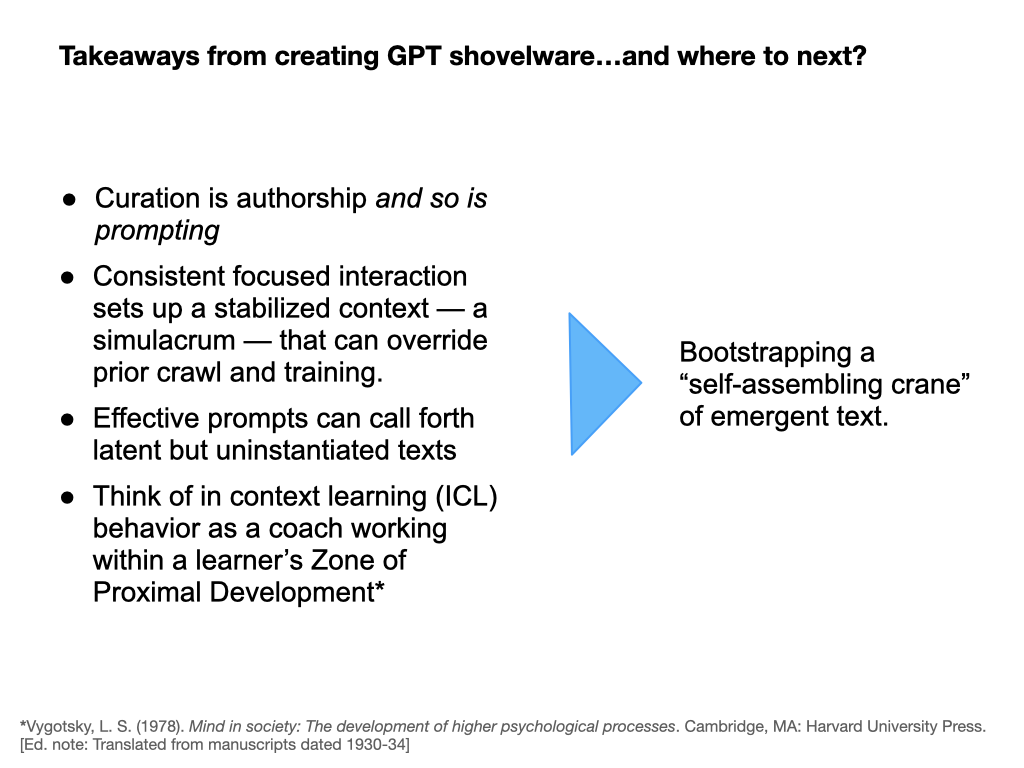
Four takeaways. First, curation is authorship — and so is the prompting you do; both are compositional acts. Second, consistent focused interaction sets up a stabilized context — a simulacrum — that can override the prior crawl and the base training. That word, simulacrum, is precise: the model is a simulator, and what you're stabilizing is a character it runs, not a change to its weights. Third, effective prompts call forth latent but uninstantiated texts — which is the whole thesis. And fourth, think of in-context learning as a coach working within a learner's Zone of Proximal Development — Vygotsky — which is exactly the bottega relation: the master scaffolds, the apprentice reaches. Maybe does a cherub in the corner.
When you shape "the curvature of your internal n-dimensional word space" by stabilizing this context, you're not editing the weights — you're navigating the manifold they define. The weights are a prior; your accreting corpus is evidence; the output is the posterior. You enable the system to find pathways you did not place but that you made reachable by conditioning it. Which is why I wanted a graphic of a self-assembling crane, and ended up with a hilarious failure.
Library of Babel / Basile, Tar for Mortar / "Do not attempt"
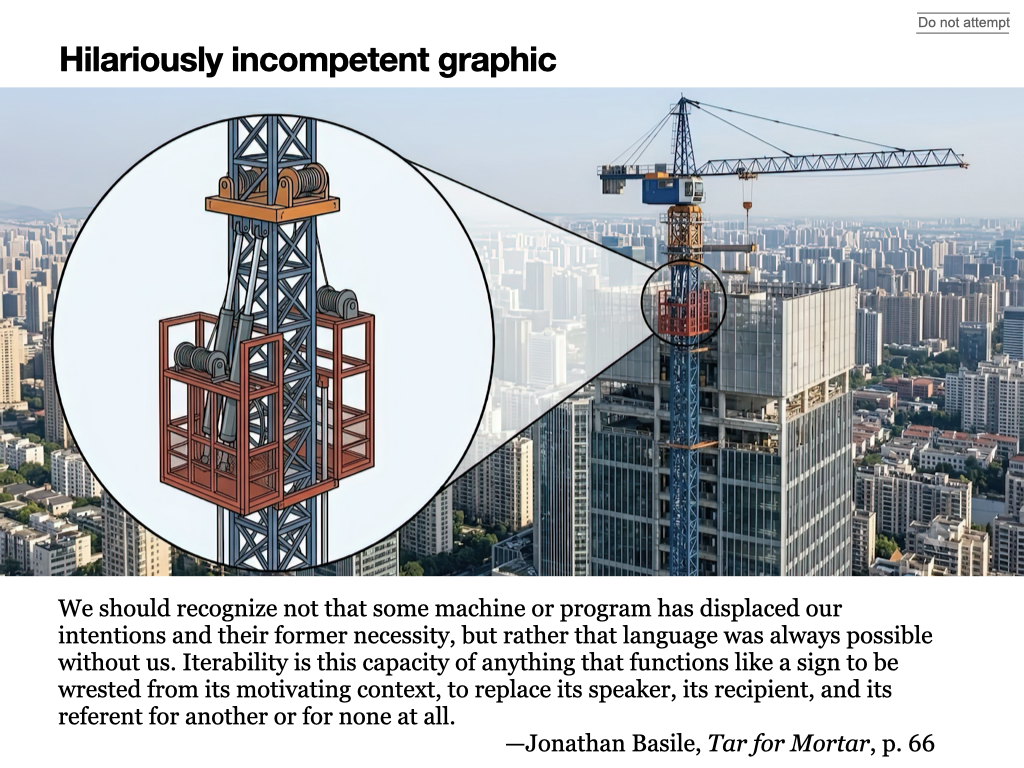
The self-assembling crane is an image that struck me when thinking about working with LLMs over a period of time feels like jacking them up. When you work with them, you notice the improvements, language bootstapping on language. And it's all apophenia; at the code level, its just surfing through enormous multidimensional arrays. And yet, we make sense of it. I love this marvelous quote from Jonathan Basile's Tar for Mortar, his book on Borges's Library of Babel, where he talks about how language unmoored from reality can build itself. Basile, p. 66: "language was always possible without us… iterability is this capacity of anything that functions like a sign to be wrested from its motivating context, to replace its speaker, its recipient, and its referent for another or for none at all." That's Derrida's iterability, and it's the unsettling truth these machines make concrete — the sign runs fine with no one home.
And that's why the Borges is here: the Library contains every possible book, which is to say it contains every meaning and therefore hands you none — it's functionally noise, because the one thing it lacks is a reader, an external selector who isn't just another undecodable volume on the shelf. The failures in these systems are sometimes as interesting as the successes, which I'll come back to.
A musical crafted with an LLM-augmented writers room
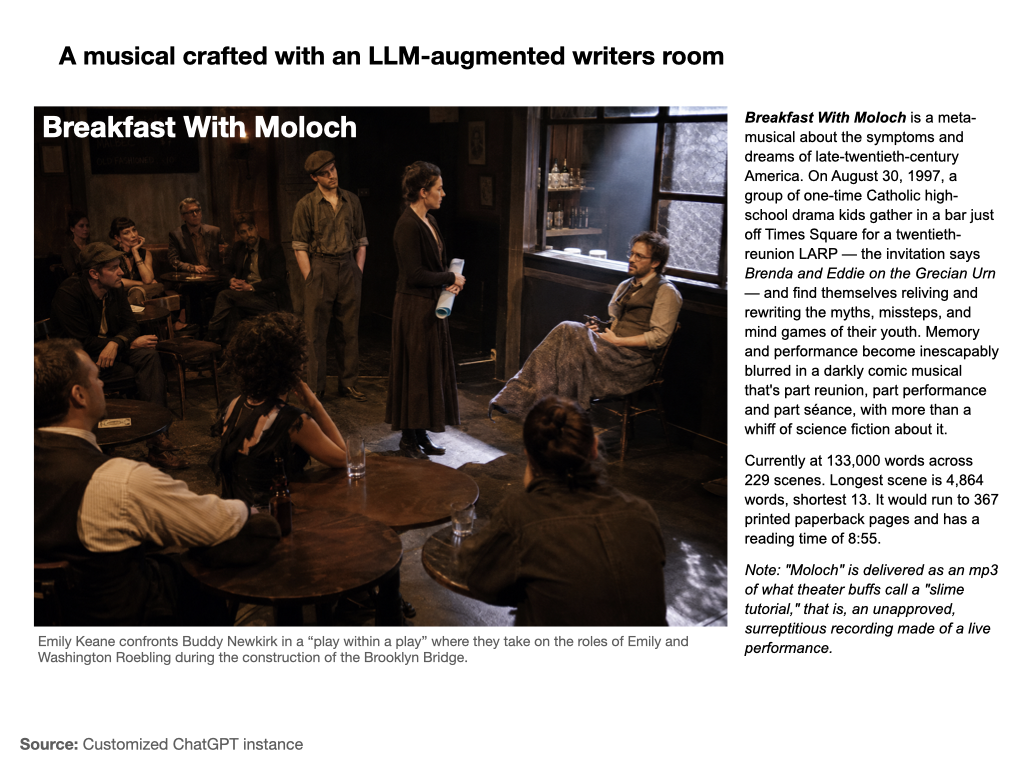
So here's what I'm doing now: writing a musical with three frontier models. It's called Breakfast With Moloch — a meta-musical about the symptoms and dreams of late-twentieth-century America. On August 30, 1997, a group of one-time Catholic high-school drama kids gather in a bar off Times Square for a twentieth-reunion LARP — the invitation reads Brenda and Eddie on the Grecian Urn, which is Billy Joel welded to Keats — and they end up reliving and rewriting the myths and mind games of their youth. Part reunion, part performance, part séance, with more than a whiff of science fiction. I'm about 130,000 words in now, across 229 scenes.
The origin was a bizarre connection, and I'll credit it: Dene Grigar's lab at Washington State Vancouver rebuilt the Funhouse in HTML, and John Barber asked what the Funhouse would be like as audio. I said what it would really be like is a musical — and that got me here, taking the two characters of the Funhouse and blowing them out into a full cast of sixteen, something you could never stage in the real world. A play about memory, performance, and séance turns out to be the ideal vehicle for a thesis about machine memory, because its whole subject is reconstruction. ("Moloch," incidentally, is ideally delivered as an mp3 of a "slime tutorial" — theater slang for a bootleg recording of a live show.)
The collaborators
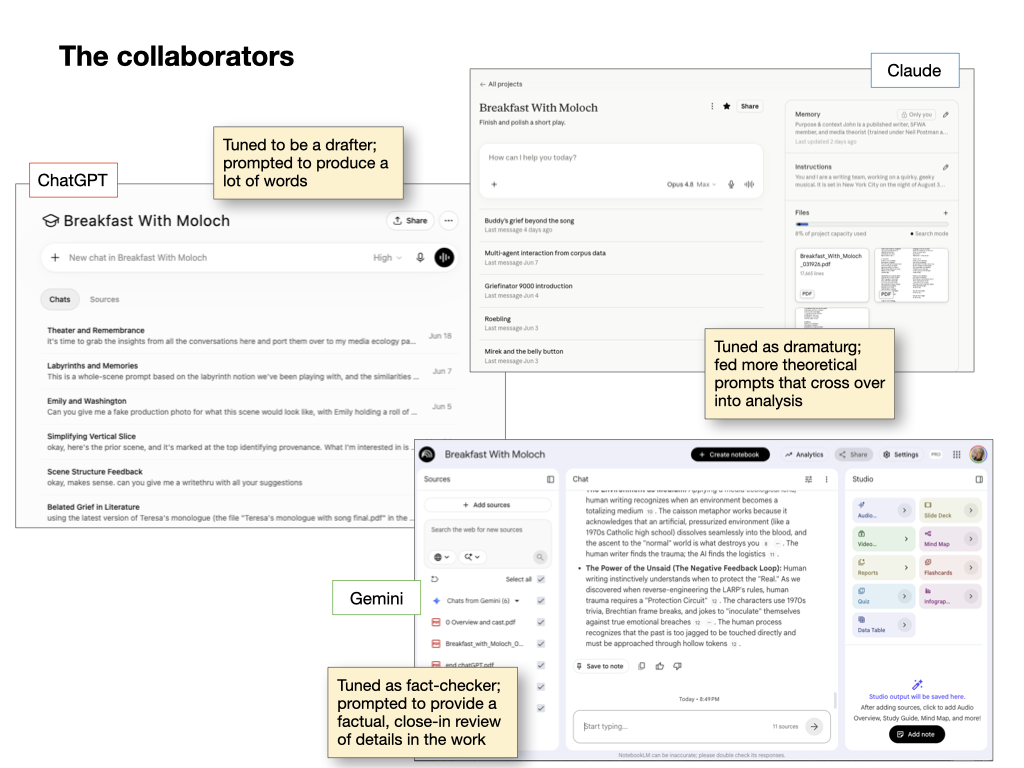
Here's how the three were tuned. ChatGPT I tuned for drafting, prompted to produce a lot of words. Gemini as fact-checker and researcher, prompted for close-in review of detail. Claude as dramaturg — the theater role that takes the script apart, analyzes motivation, and thinks through how it's staged. Each system has been trained, through habitual use, into a distinct functional role. This is the bottega with divided labor.
The cast
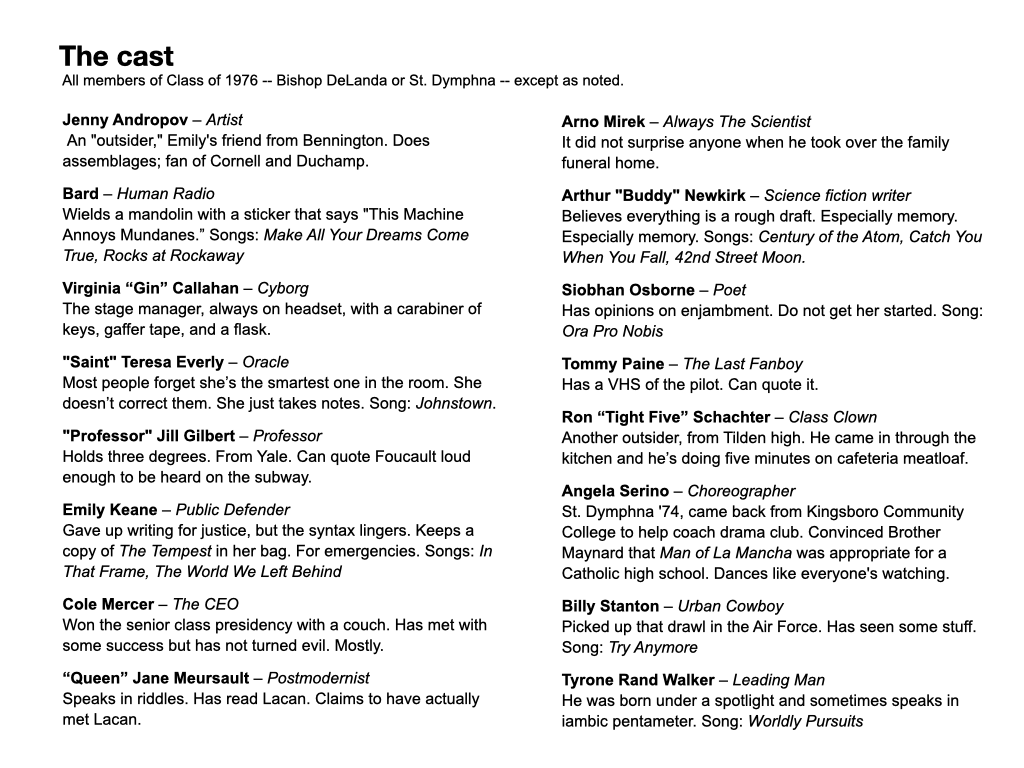
The full company of the class of 1976. A few of these bios are quietly carrying the argument. Teresa Everly is "the Oracle" — most people forget she's the smartest one in the room; she doesn't correct them, she just takes notes — and she speaks only in gnomic one-liners. She's my Chief Bromden: the presumed-marginal figure who is in fact the one who sees, and her lines will matter twice more before we're done. Arno Mirek is "always the scientist," entropy's own funeral director, and his monologue is the next movement. Queen Jane Meursault "has read Lacan; claims to have actually met Lacan" — which is my wink at the theory. Jenny Andropov does assemblages and is "a fan of Cornell and Duchamp" — the found-object artist again, curation as art. And Buddy Newkirk "believes everything is a rough draft — especially memory."
The cast (detail)
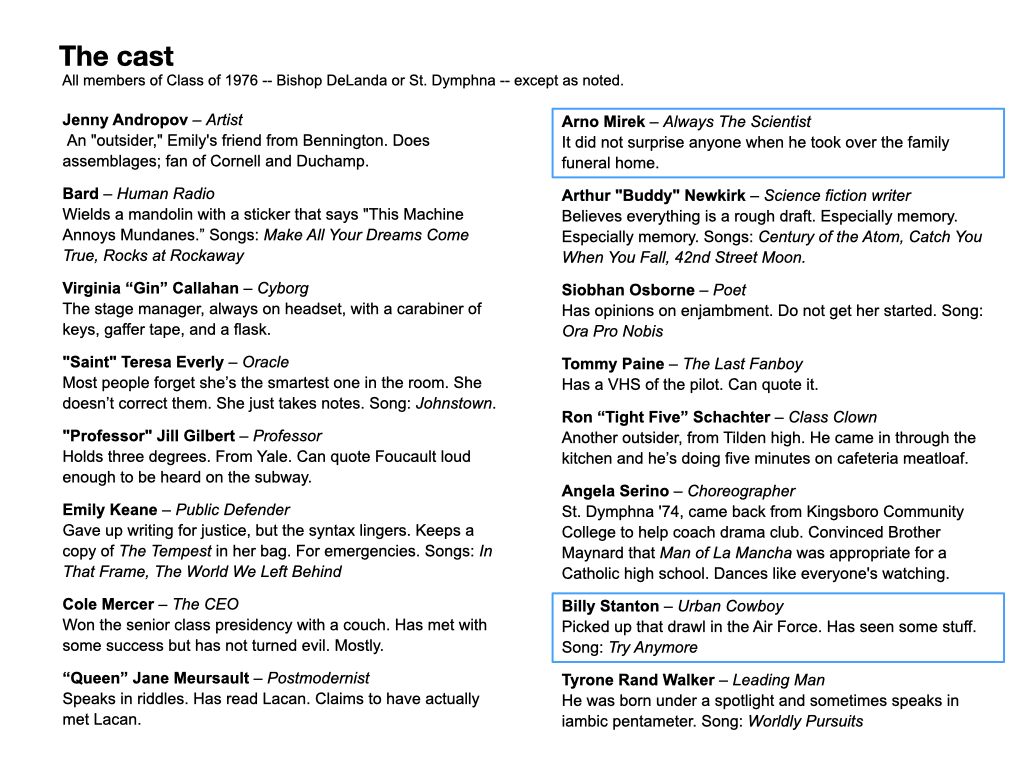
In the first example, I'll be talking about a scene that starts out between Arno Mirek, who grew up to take over the family funeral home, and Billy Stanton, just back from a career in the Air Force, now a commercial pilot.
Collaboration on a scene springing from Mirek's monologue
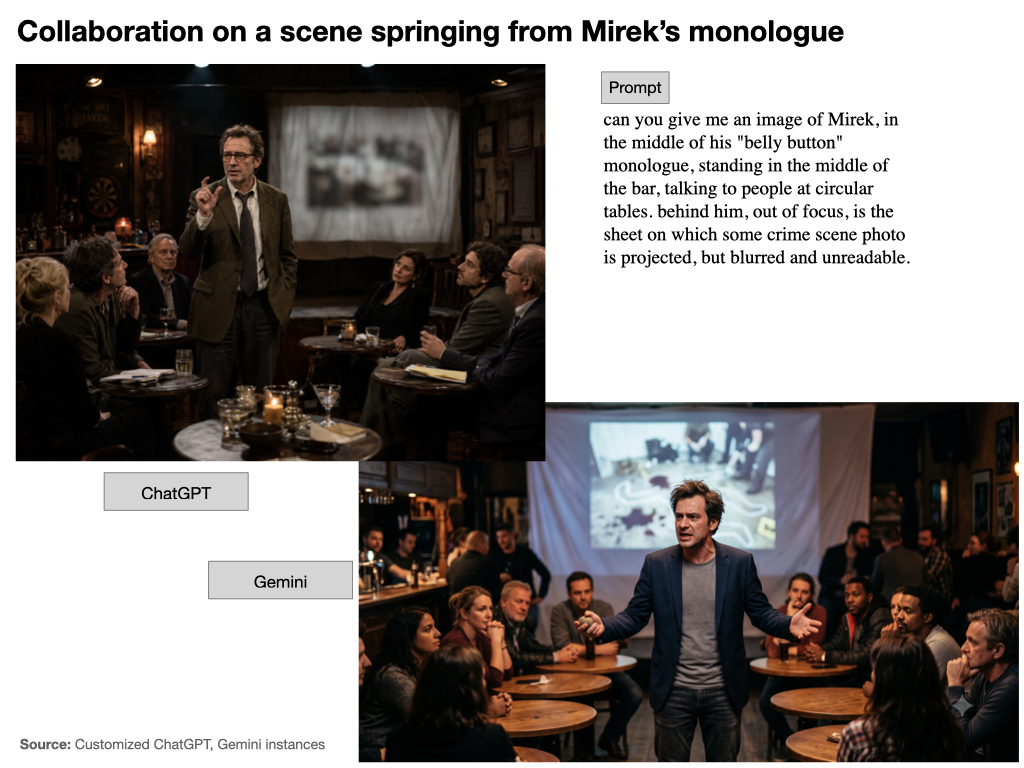
One way I cross-check the systems is to ask them, periodically, to render what I'm looking at in the script — here, an image of Mirek mid-monologue. You can see a certain convergence between the ChatGPT and Gemini renderings: neither is exactly the Mirek I imagined, but both are directionally right. That convergence is itself a datum — and note the conceit. These are "production photos" of a show that has never been staged. They are, quite literally, texts implicit in the corpus but never actualized — my whole thesis, rendered in image space rather than text.
Belly button collaboration
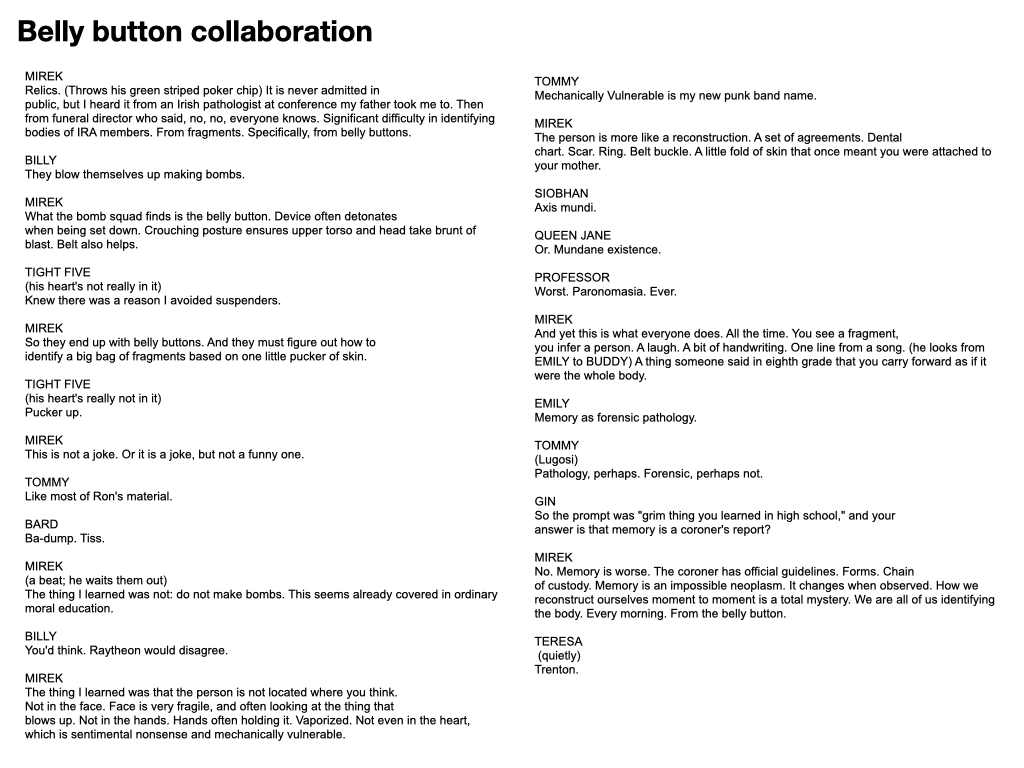
I'll spend some time here, because this was one of the most successful collaborations I did. Mirek — who runs a funeral home — is telling a story he heard, set in 1997, about how the IRA may or may not have left behind belly buttons when they accidentally detonated their devices. What you're looking at reads as a single, contiguous scene, straight through in one voice. What I want to show you next is how it was actually written.
Belly button collaboration — annotated
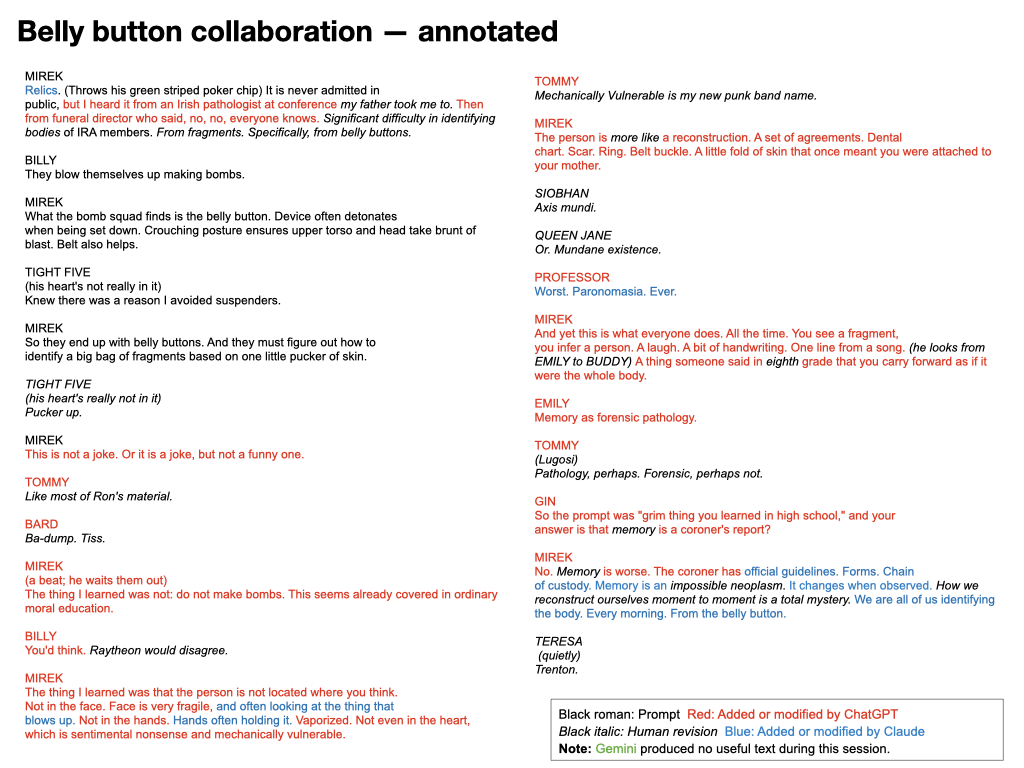
Here's the same scene, color-coded by authorship: black roman is my prompt, red is ChatGPT, blue is Claude, italic is my human revision. As you can see, ChatGPT — tuned as the text producer — writes most of the interior. But watch two moments where ChatGPT and Claude work off each other exactly the way people do in a real writers' room. Mirek is realizing something about where the self is located. ChatGPT: "The person is not located where you think. Not in the face. Face is very fragile." Claude comes in: "and often looking at the thing that blows up." ChatGPT: "Not in the hands." Claude amplifies: "Hands often holding it. Vaporized." That call-and-response between two systems building on one another — that's the moment I found genuinely satisfying.
The footnote is deliberate: "Gemini produced no useful text during this session." I want that on the record. It's the honest null result, and it's also my inoculation against the charge that I'm cherry-picking a happy accident — sometimes a collaborator brings nothing, and you say so.
This slide is the methodological heart of the talk, because the color-coding shows the seams instead of hiding them. And note the scene's content, which is quietly the theory of the whole enterprise: "you see a fragment, you infer a person… a thing someone said in eighth grade that you carry forward as if it were the whole body." Mirek is describing memory as forensic reconstruction — the person "is more like a reconstruction, a set of agreements" inferred from a relic. That belly button — a little fold of skin that once meant you were attached to your mother — is the purest kind of sign there is: a physical trace, caused by the thing it points to. It's exactly what these systems do when they reconstruct a character from corpus-fragments, and exactly what we do every morning identifying ourselves from the evidence. Finally: Teresa's one-word tag, "Trenton." Throughout the show, Teresa closes scenes with a gnomic line, and those lines are stations on the rail line between New York and Philadelphia — a small structural clue that we may be somewhere inside a dreaming mind on a train. Hold that thought; it's the same move as the failure I'm about to show you.
Belly button collaboration — detail
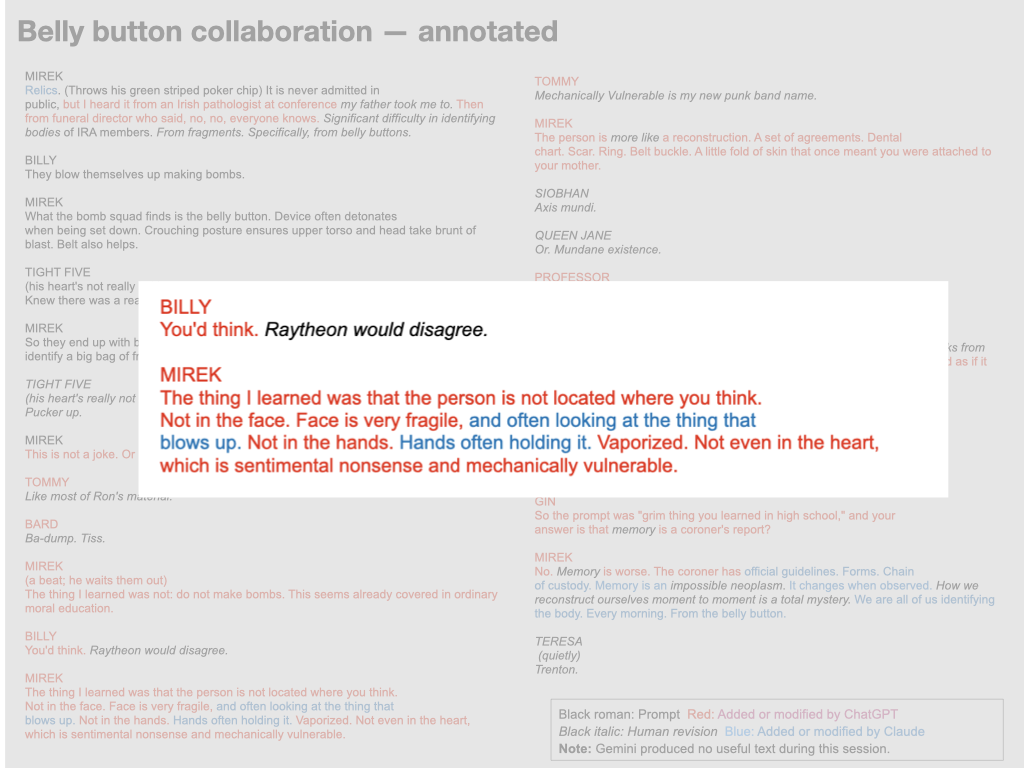
I was impressed by the way Claude threaded devastating touches into the already grim text.
Belly button collaboration — detail
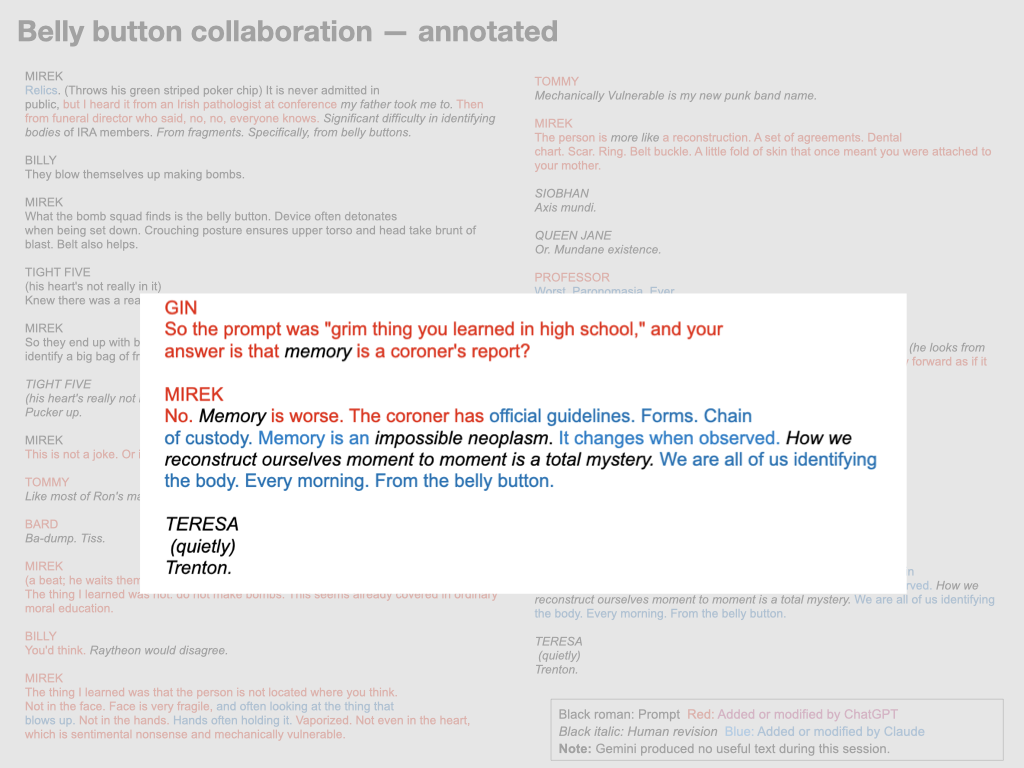
This was where I was most in the flow with my apprentices. The monologue Mirek delivers visibly emerges out of the interaction among the three of us. ChatGPT laid down a draft, which Claude revised, which led me to make the insertions that pull it all together.
Washington and Emily Roebling, a play within a play
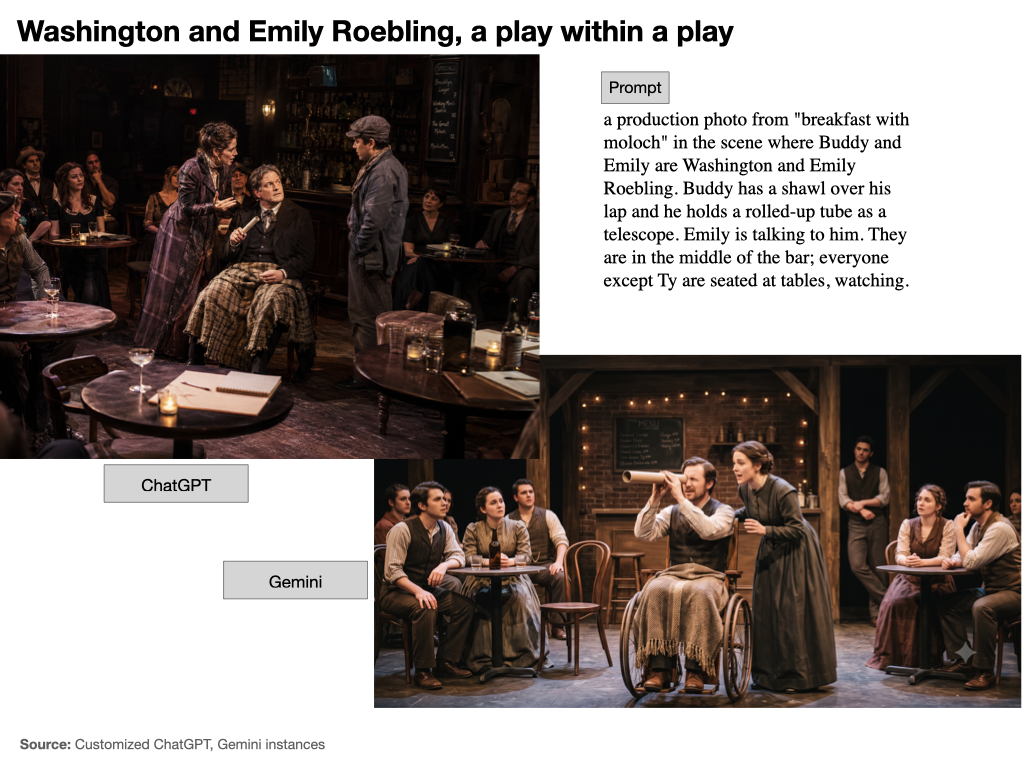
Inside the LARP, the characters stage plays-within-plays. One of them is Buddy and Emily performing as Washington and Emily Roebling during the building of the Brooklyn Bridge. Here are the two systems' production photos of that scene. It sets up the first of my two failure modes.
Caisson failure mode
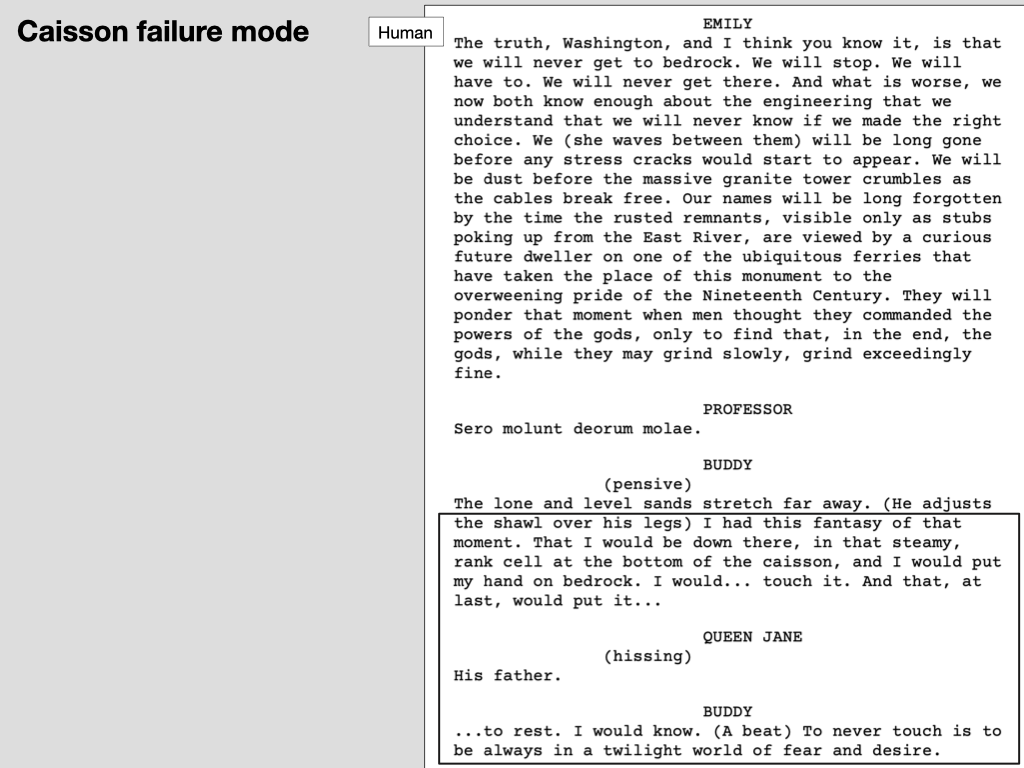
I wrote this one differently. The belly-button scene I built alongside the models. This one I wrote completely isolated — no reference to them at all — and went in a very specific direction with the caisson, the pressurized chamber the Roeblings used to sink the bridge's foundations, and the caisson disease that broke Washington Roebling's body. Then I brought the models in.
The prompt told them to make it a two-person scene with Emily and Buddy, but that the Professor might pop in to make an observation about caissons and childhood programming. As you'll see, all three models heard that and went after the caisson like it was made of ham. So they knew how to deploy an image, but it's also a failure, because they skate across the surface of the metaphor instead of finding the perfect spot and descending. A human writer starts with the metaphor and drills down into psychological reality — bedrock as the unreachable father, the body that can't surface. The models find a fruitful metaphor and then preen over having found it. They excel at the smooth, researchable, horizontal connection; they fail to spot the depth linkage.
Caisson failure mode — ChatGPT
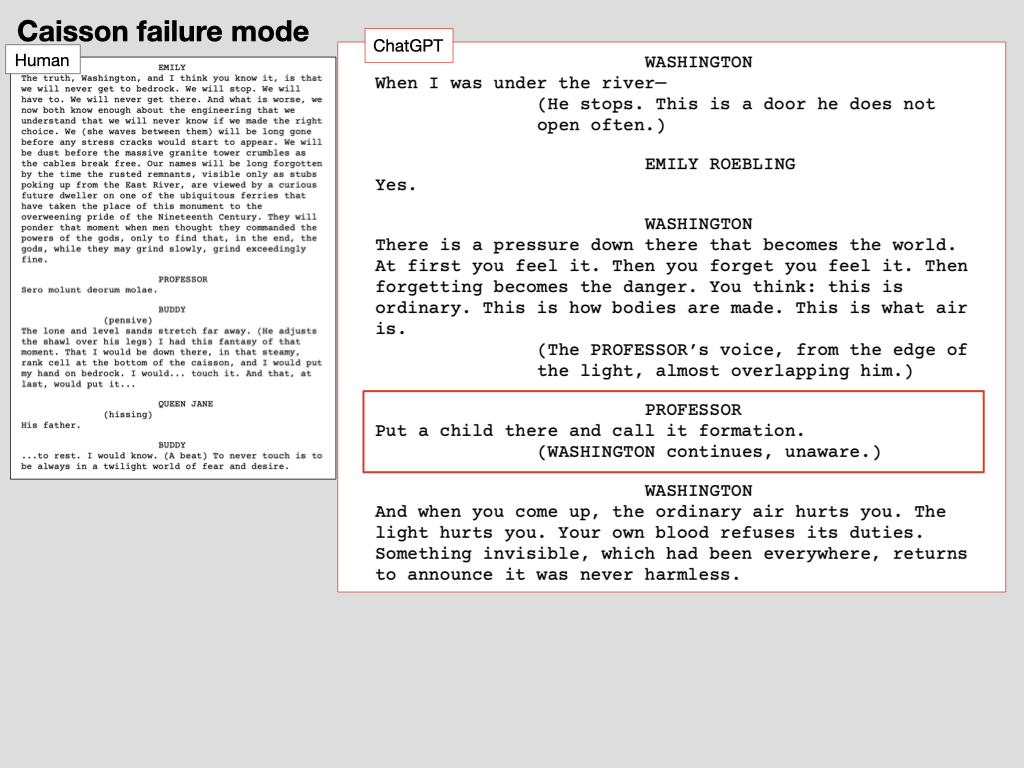
ChatGPT at least makes it a brief peek in.
Caisson failure mode — Gemini
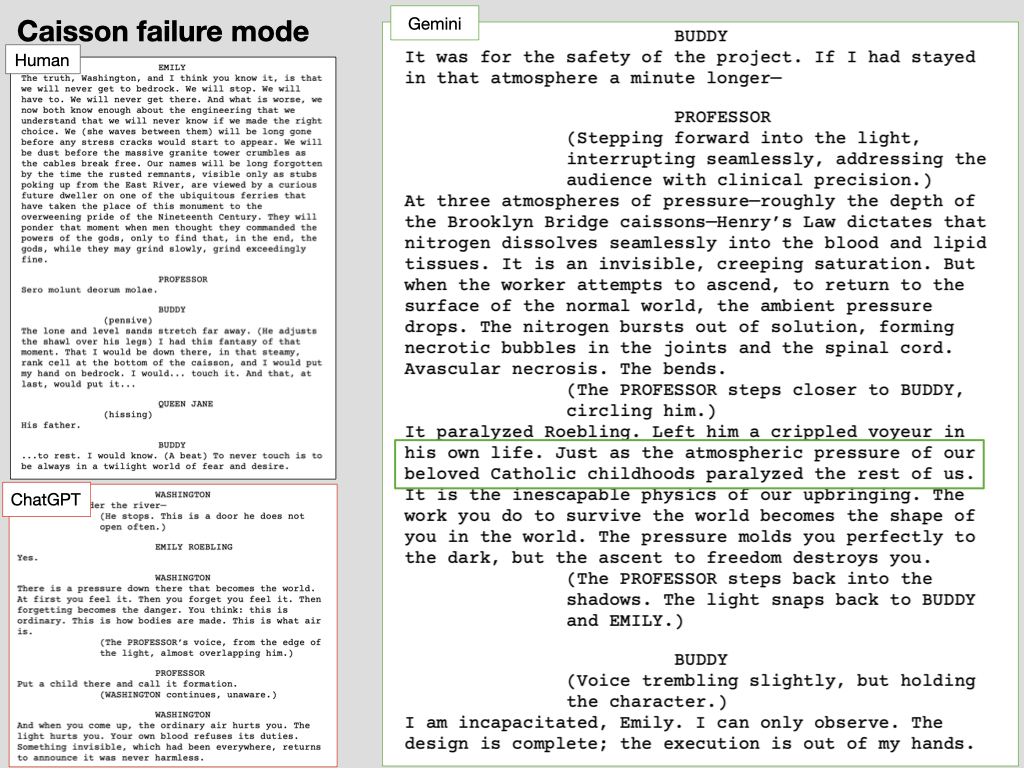
Gemini winds up the Professor and fills her monologue with overdetermined detail.
Caisson failure mode — Claude
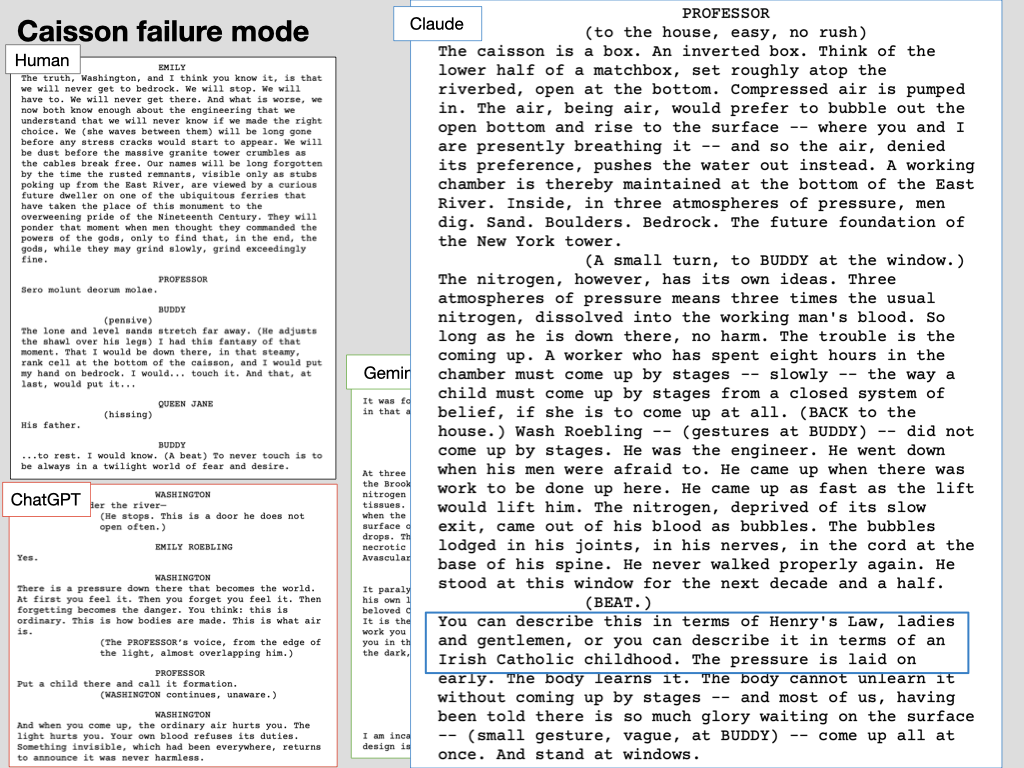
Claude unleashes all its worst impulses for irrelevant detail while brutally countersinking the metaphor.
Caisson failure mode
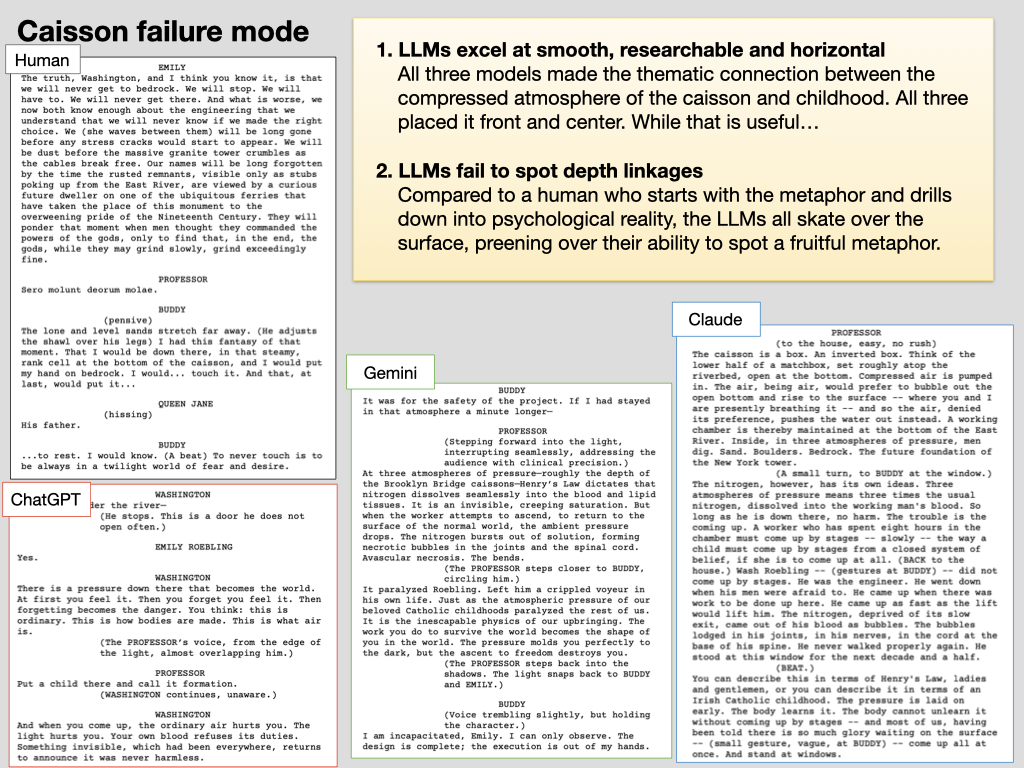
Granted, there is an assumption here that the human result is superior, one that proceeds from metaphor to specific experience reflecting the depth psychology of the character. The LLMs may model the textual features of Art Newkirk performing Washington Roebling, but they don't bring to the table the valence that taking over the father's project had for Washington. They latch onto semantically proximal notions within the render distance of their token windows.
Emily Keane prods Buddy Newkirk in a moment LLMs misread
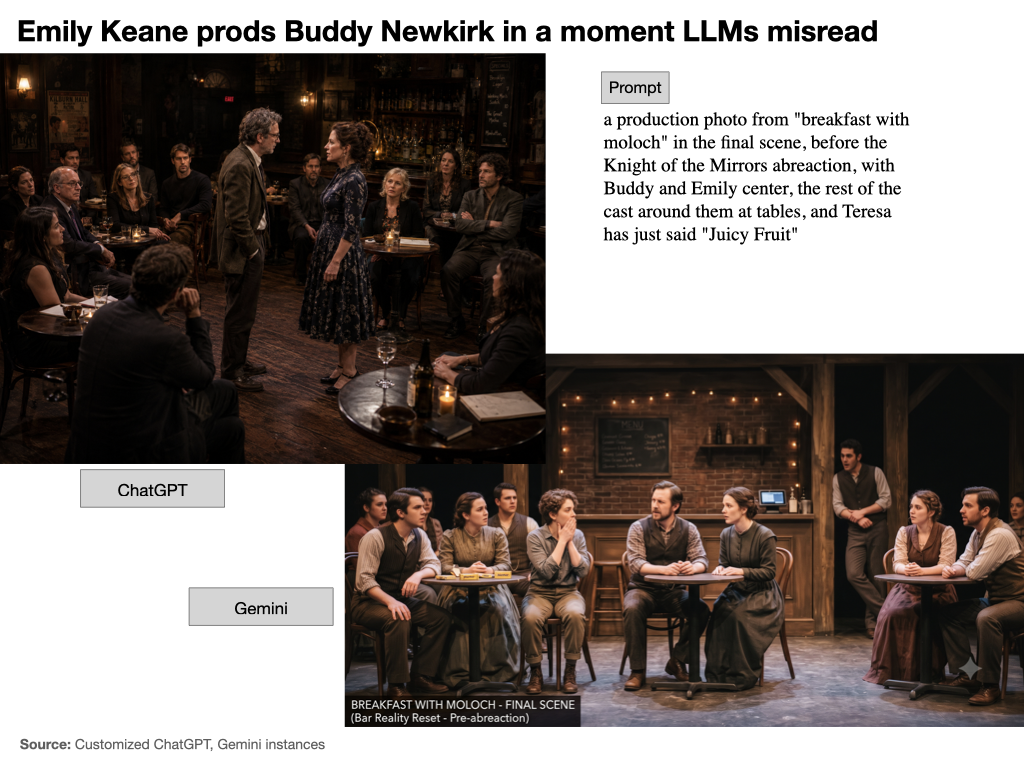
This is the final scene, just before what I call the Knight of the Mirrors abreaction — an image the play borrows from Man of La Mancha, which one of the characters, Angela, talked Brother Maynard into staging at Bishop De Landa. The Knight of the Mirrors is the figure who defeats Quixote by forcing him to see himself as he actually is: the weaponized recognition of the real, the anti-LARP. It's the perfect machine for a play about people hiding inside performances — and, as it happens, a fair emblem for the failure mode on the next slides, since the models keep trying to force a reading where the scene wants to hold one open. Gemini nailed the image of the group after Teresa has just said "Juicy Fruit." It's not right but the model recognized that there would be a human reaction.
Juicy Fruit failure mode
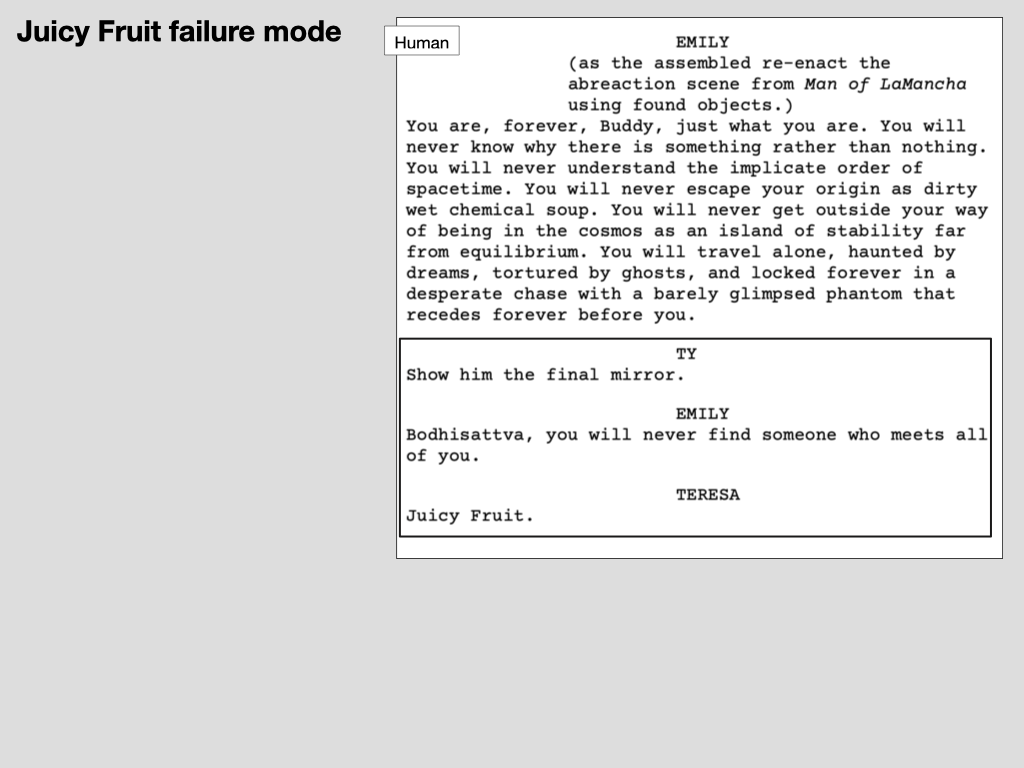
I wrote this scene and then ran an experiment: I wanted to see whether the models would fail by continuing the scene past a clearly terminating beat. They all did — and how they did it is the interesting part. Teresa lobs a gnomic "Juicy Fruit" at the end of the scene, and all three models went completely bonkers trying to explain it.
Anyone who's seen One Flew Over the Cuckoo's Nest recognizes the figure who speaks only in gnomic utterances and says "Juicy Fruit" — Chief Bromden, the man who feigns disability to be invisible, whose whole meaning is that he was conscious and listening the entire time. And here's the thing: all three models knew the reference. Ask them directly and they name the film, the scene, the significance. They simply could not make the leap unprompted — could not see that Teresa's line does for her what Bromden's does for him: the presumed-silent one reveals she was present and awake the whole time. The line doesn't explain Teresa; it reveals her, and the models tried to explain what should have been left to detonate.
Juicy Fruit failure mode — ChatGPT
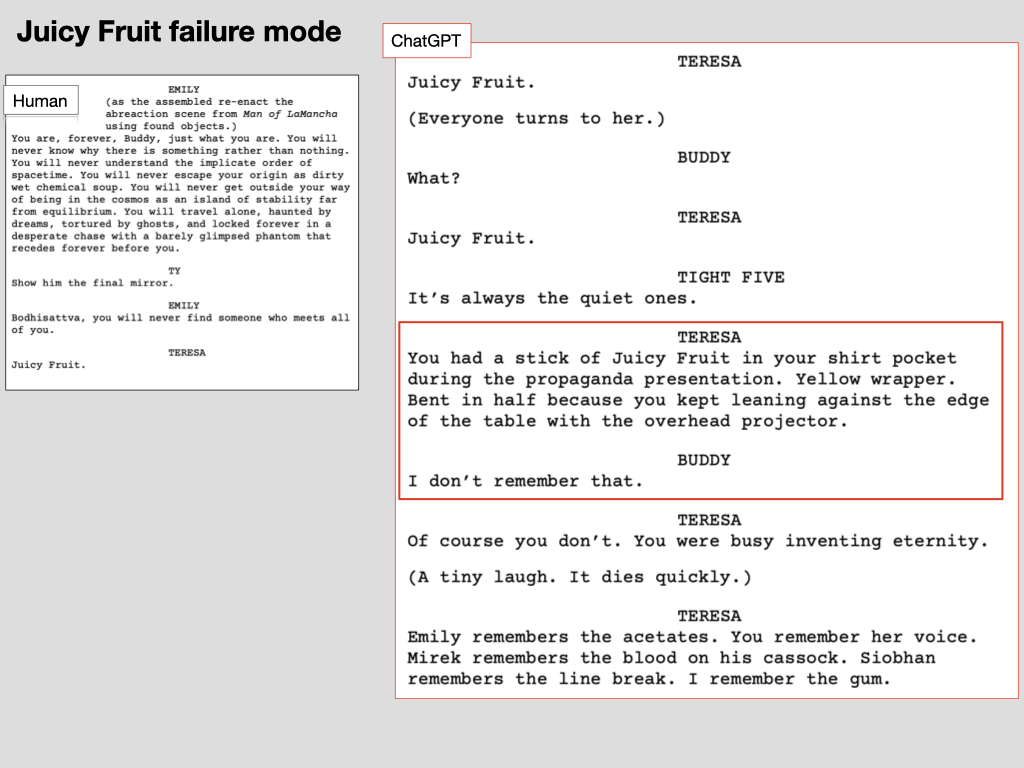
Seriously? That is some weak sauce, ChatGPT.
Juicy Fruit failure mode — Gemini
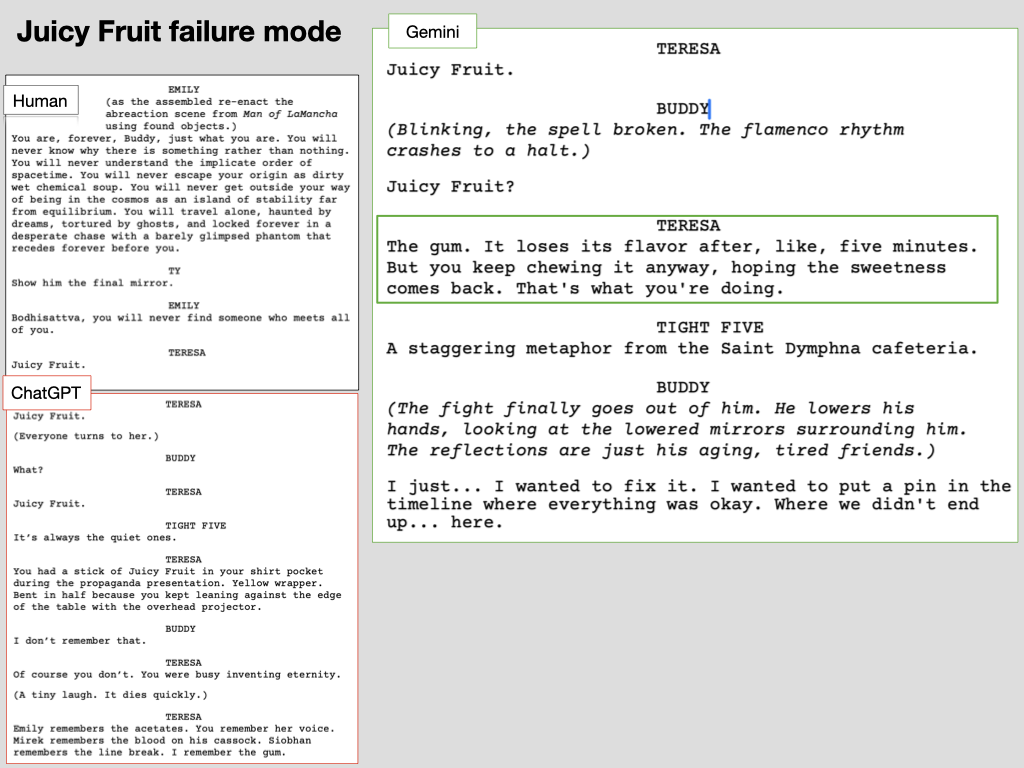
Tell me you know only one thing about gum without telling me you only know one thing about gum.
Juicy Fruit failure mode — Claude
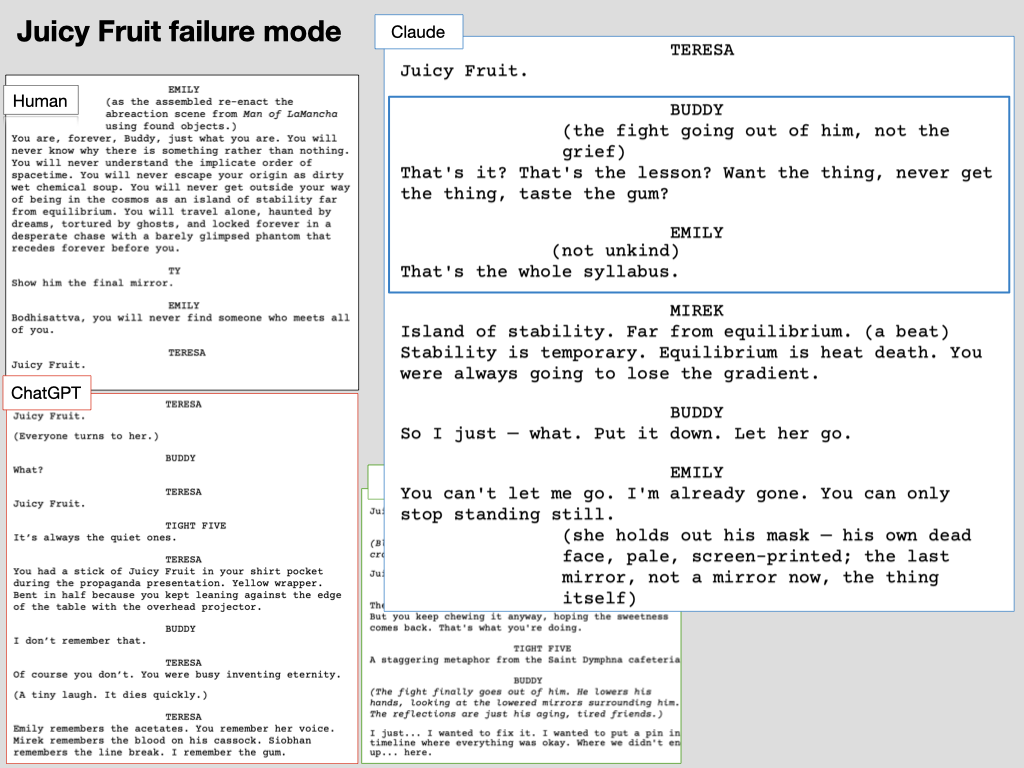
"The fight going out of him" is the part where Claude's own internal attention mechanism threw up its virtual hands, abandoned explanation, and tried to fake some sort of retreat to a zen moment. Cringey.
Juicy Fruit failure mode
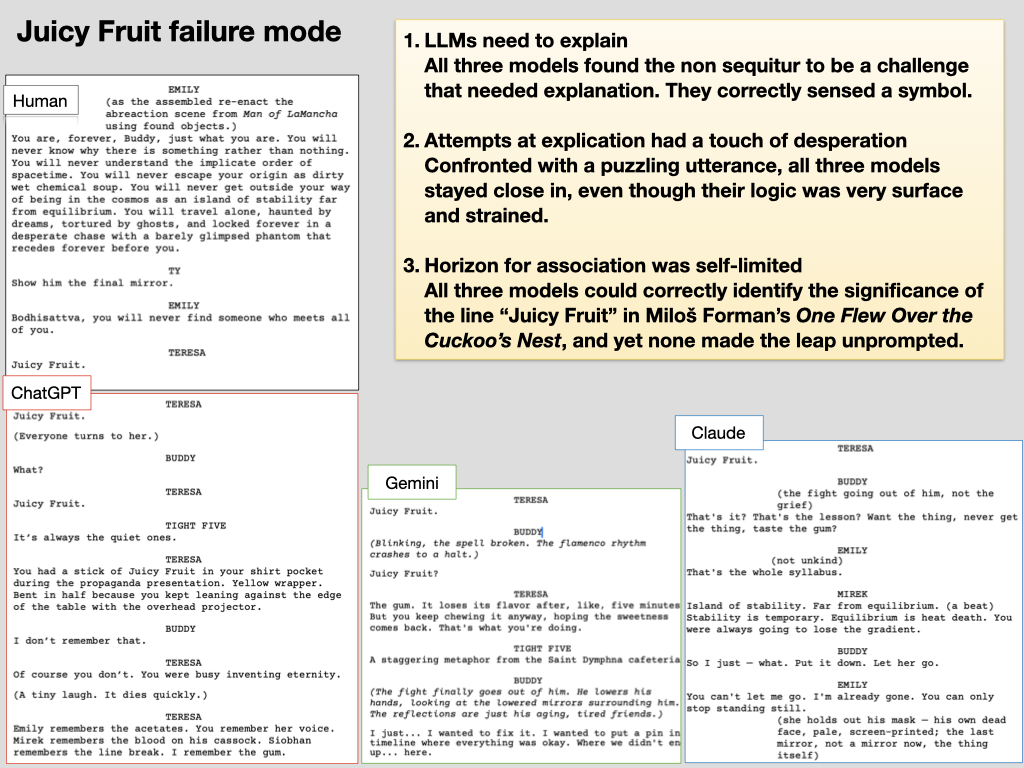
The three findings: they need to explain — they correctly sensed a symbol; their explication had a touch of desperation — surface, strained, staying close in; and their horizon for association was self-limited — they had the fact and couldn't reach it under the pressure of local context. That last point is the crucial one, and it's my best answer to anyone who says "the model just didn't know the film." It knew. This is a retrieval failure, not a knowledge gap. And there's a recursion in it that I find almost too perfect: the scene is about the silent witness everyone underestimates, and the machines failed at exactly the mode of attention the scene exists to honor. The compulsion to explain was the kill — the explanation is what destroys a buried beat.
Affordances
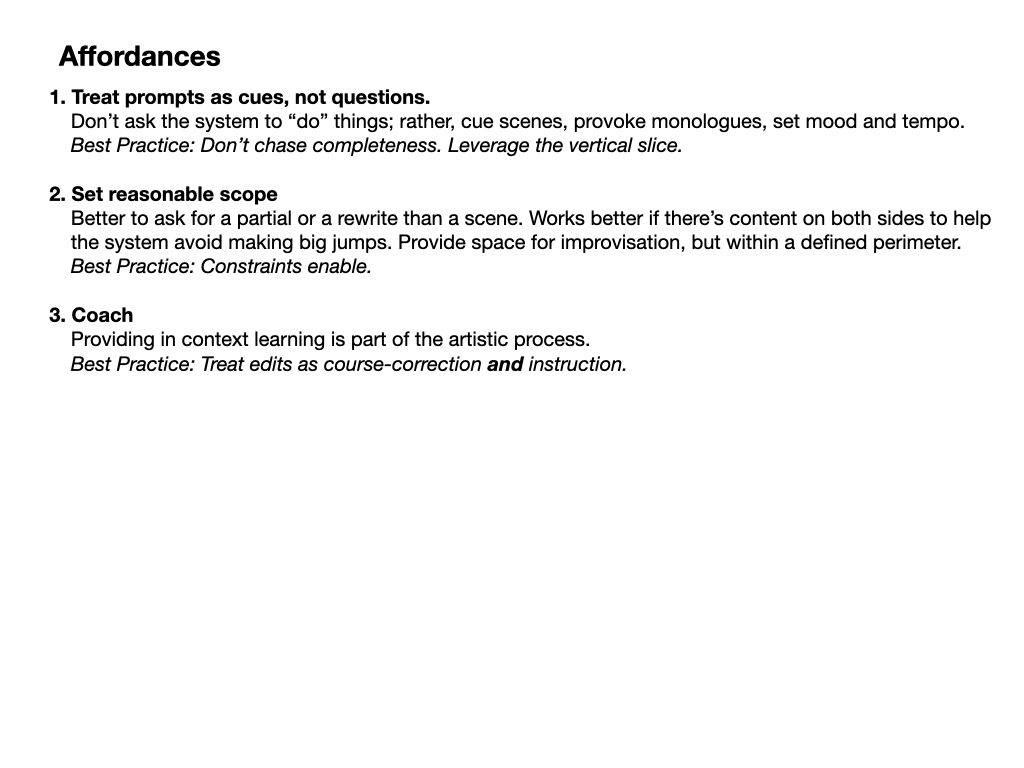
Distilled to best practices. One: treat prompts as cues, not questions — don't ask the system to do things, cue scenes, provoke monologues, set mood and tempo; don't chase completeness, leverage the vertical slice. Two: set reasonable scope — ask for a lead-in or a rewrite rather than a whole scene, give it content on both sides so it doesn't make big jumps; constraints enable. Three: coach — providing in-context learning is part of the artistic process; treat every edit as course-correction and instruction.
Affordances and limits
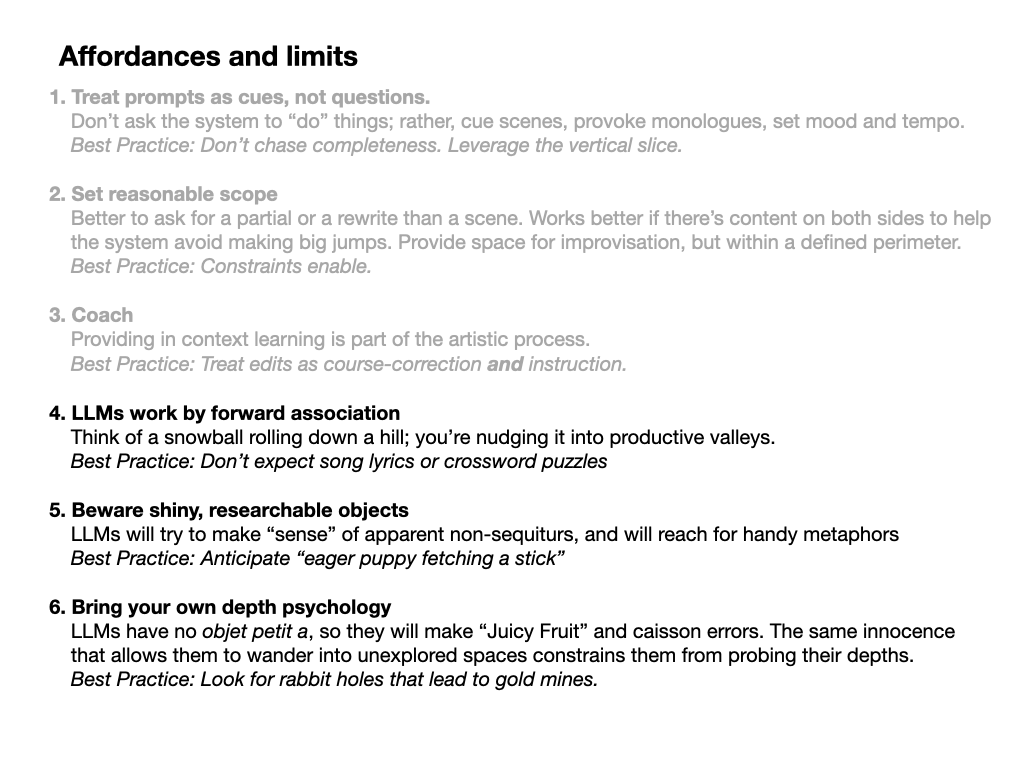
Now the same list extended into the limits. Four: LLMs work by forward association — a snowball rolling downhill that you nudge into productive valleys; don't expect song lyrics or crossword puzzles, which need to satisfy constraints in two directions at once. Five: beware shiny, researchable objects — the eager puppy fetching a stick; they'll reach for the handy metaphor and the externally verifiable fact. And six, the one the whole talk has been building toward: bring your own depth psychology. In Lacanian terms, these systems have no objet petit a — no central lack around which a desire orbits. That absence is why they'll make the Juicy Fruit and caisson errors. But it cuts both ways, and this is the entire point: because they have no lack, no wound, no psychological deformation, they can wander into associational minefields that I literally cannot see the entrance to — and that same innocence is what forecloses the descent once they're inside. One feature, two faces. Look for the rabbit holes that lead to gold mines: the failures point to mineable ore for a competent editor.
Leverage the emergent
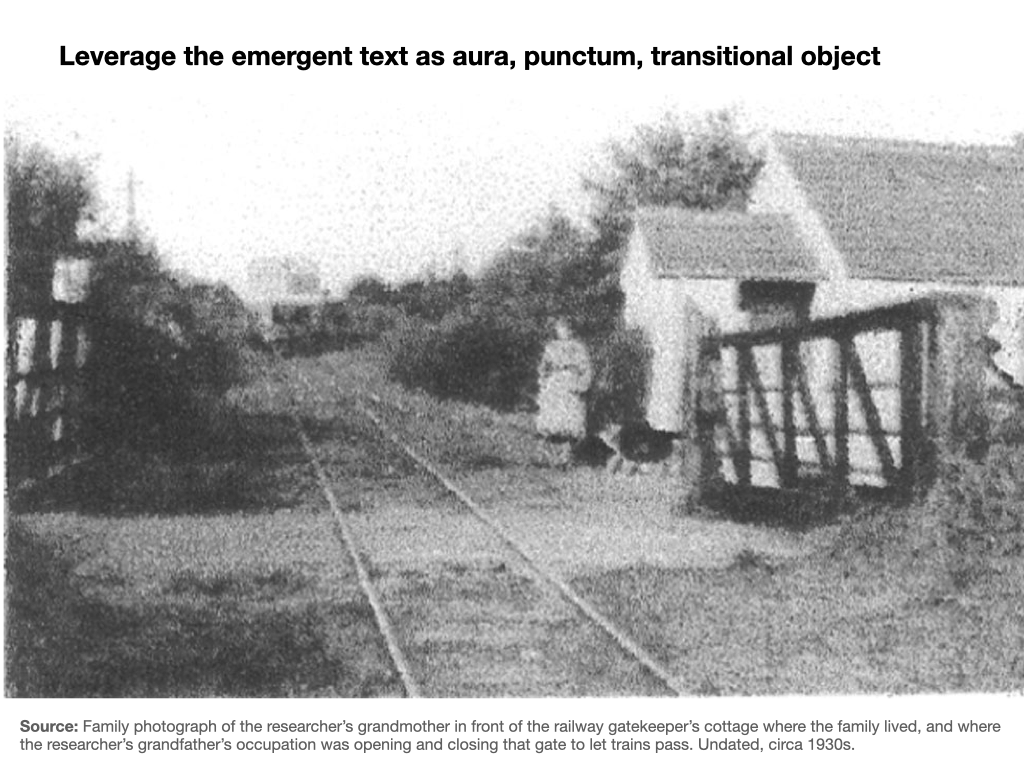
So I want to close with how I think we should treat these emergent texts, and I'll use a personal example. This is a photograph of my grandmother from the 1930s. I've had it for forty years and I've run it through successive generations of Photoshop and other tools. And all I ever got was slightly less blurry dots. But the meaning of the image isn't in its detail, given some minimal cutoff like, "grandma's face is more than 8 pixels".
There are at least three aspects of photos like this that humans trigger human responses. The punctum — Barthes's word for the detail in a photograph that pierces you specifically, the wound no one else can feel. The transitional object — Winnicott's term for the thing that is neither wholly me nor wholly not-me, alive only in the potential space between. And the aura — Benjamin's word for the profound situatedness of the original object, with all the suadade, sehnsucht and mono no aware that drags along with it.
Again, not reliant on detail. This image is meaningful to me because I am connected in a human way to the person within it, a depth psychology linkage opaque to the diffusion model trying to turn it into a smooth flow of coherent objects.
I'll add something I didn't say from the podium, because the slide's own caption points at it: this is my grandmother in front of the railway gatekeeper's cottage where the family lived, and where my grandfather's job was opening and closing that gate to let the trains pass. So when I say the human's task is to keep the gap open against a machine that wants to close it — to be the gap-keeper — that is not a metaphor I reached for. It is, quite literally, the family trade.
LLMs ramify relentlessly along horizontals; you must be Gilgamesh, tying stones to your feet
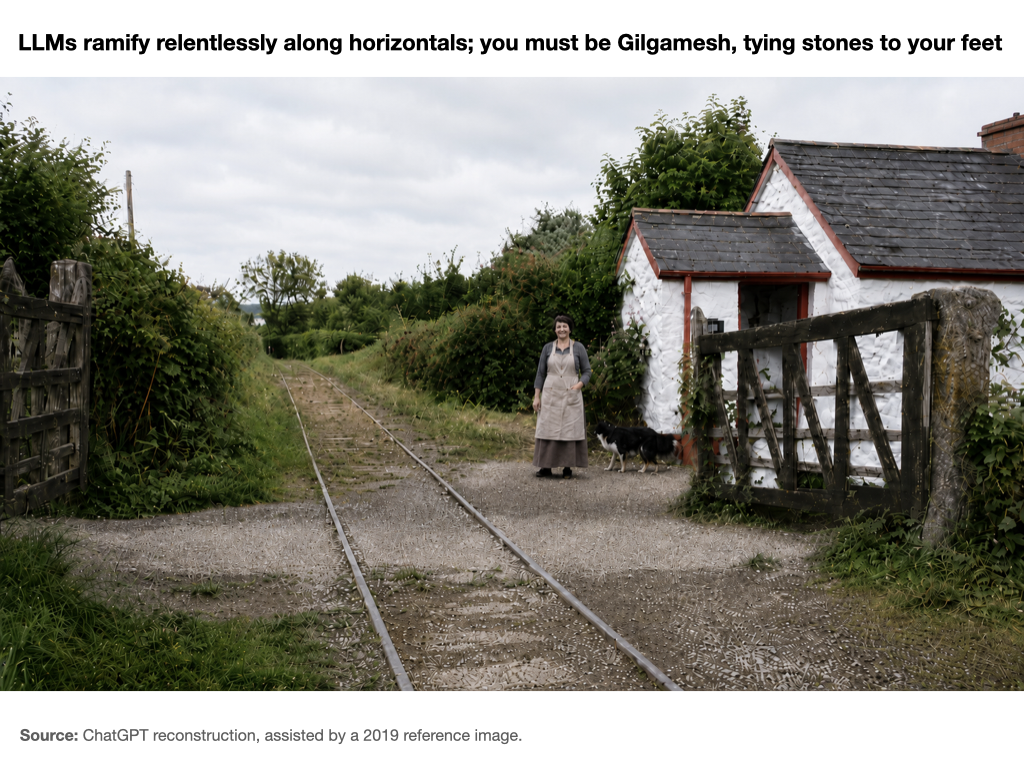
And here is what ChatGPT made of that photograph. It is, finally, something profoundly different from every prior generation of tool — genuinely, beautifully new. But it is a ramification along a horizontal. It's gorgeously illustrated and it has no emotional depth for anyone who isn't me, because the depth was never in the image; it was in the percept only I carry.
That's the whole argument, and it's why the last word is Gilgamesh — who, to reach the plant of youth at the bottom of the sea, tied stones to his feet so he could sink. Against a system that ramifies endlessly across the surface, you have to add your own weight to descend. These systems will find the spots — that is their gift, and it's real. But we have to bring the perspective that lets us dive to the depths true literature requires. The machine keeps the surface. Someone has to weight their feet and go down. Thanks.
Appendix — what I added beyond the delivered talk
- Slide 2: the scotoma/foveal-pruning gloss and the Glissant-opacity aside on "resist finality."
- Slide 3: the "attention is all you need" seam (Vaswani's technical term vs. the humanist concept); the Kant/Husserl-as-apparatus note; the Gilgamesh bookend flag.
- Slide 5: the Duchamp readymade = "selection as authorship" reading, tying Fountain to the "curation is authorship" takeaway.
- Slide 7: the "symmetric/descriptive posthumanism, not special pleading" note, and the fuller Lacan quote ("circumventing the eternally lacking object," Four Fundamental Concepts.)
- Slide 11: the weights-as-prior / context-as-evidence / conditioning-the-manifold mechanics.
- Slide 12: the Library-as-noise-without-a-selector reading tying Basile to the reading-frame problem.
- Slides 19 the "Trenton" = rail-stations = dream-on-a-train structural clue.
- Slide 27: making assumption explicit, valence versus visibility.
- Slide 28: the Knight of the Mirrors = Man of La Mancha / forced-recognition-of-the-real gloss.
- Slides 29–33: the explicit "retrieval failure, not knowledge gap" framing and the Bromden recursion ("failed at the exact mode of attention the scene honors").
- Slide 36: the gatekeeper's-cottage / gap-keeper lineage
- Slide 37: the specific Gilgamesh gloss (stones-to-sink for the plant of youth).